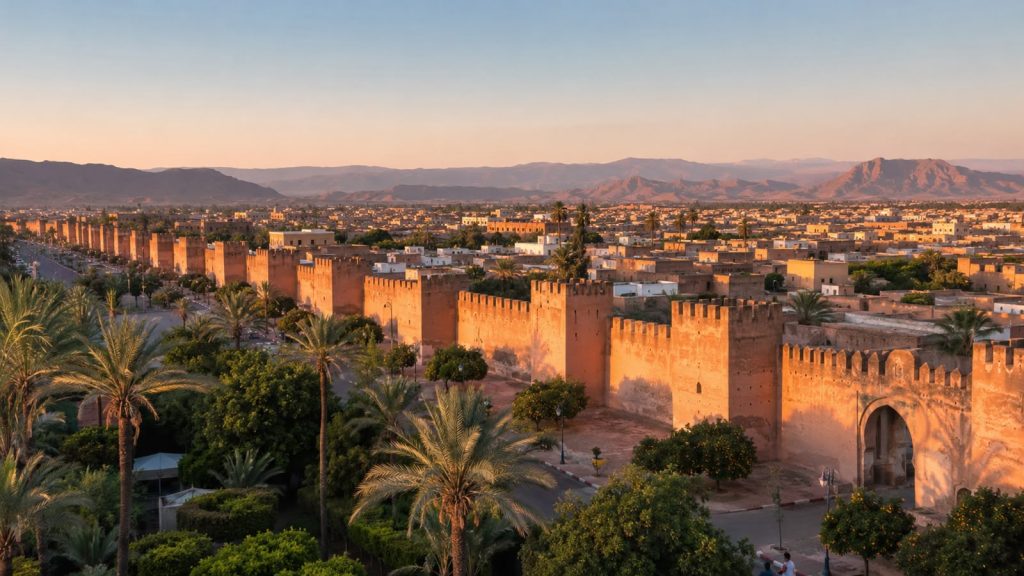
This Zagora Travel Guide introduces one of southern Morocco’s most evocative stopping points: a palm-fringed town where the Draa Valley meets the open, mineral landscapes that lead toward the Sahara. Zagora is not a resort built around one landmark. Its appeal comes from the journey itself—earthen villages, date-palm gardens, mountain silhouettes, traditional crafts and the sense of continuing south along an old caravan corridor.
Travelers often arrive from Marrakech or Ouarzazate, then use Zagora as a base for Tamegroute, Tinfou, M’Hamid El Ghizlane and longer 4×4 journeys to Erg Chigaga. The city is also a comfortable place to slow down between road-trip stages, especially when a riad, garden or palm-grove lodge is part of the experience.
The most important planning detail is geographical: Zagora is a gateway to the desert, but the town is not beside the towering dunes seen around Merzouga. Small dunes can be visited near Tinfou, while the large, remote landscapes of Erg Chigaga lie farther south beyond M’Hamid and normally require an experienced driver and a suitable 4×4. For Erg Chebbi specifically, use our Merzouga Sahara Desert Travel Guide.
Use this Zagora Travel Guide to choose the right experiences, decide how long to stay, understand the seasons, plan realistic road times and connect the destination with the rest of your Morocco itinerary.
Zagora also works as a decision point in a wider Morocco itinerary. Travelers can return north through Ouarzazate, continue toward a remote Erg Chigaga camp, or connect the Draa Valley with longer journeys across the south. The right choice depends on road time, season, mobility and whether culture or high dunes is the main priority.
This expanded guide is designed for independent planners and guests considering a private tour. It distinguishes verified geography from common marketing shortcuts, includes realistic itinerary options and explains how to support local guides, craftspeople and oasis communities.

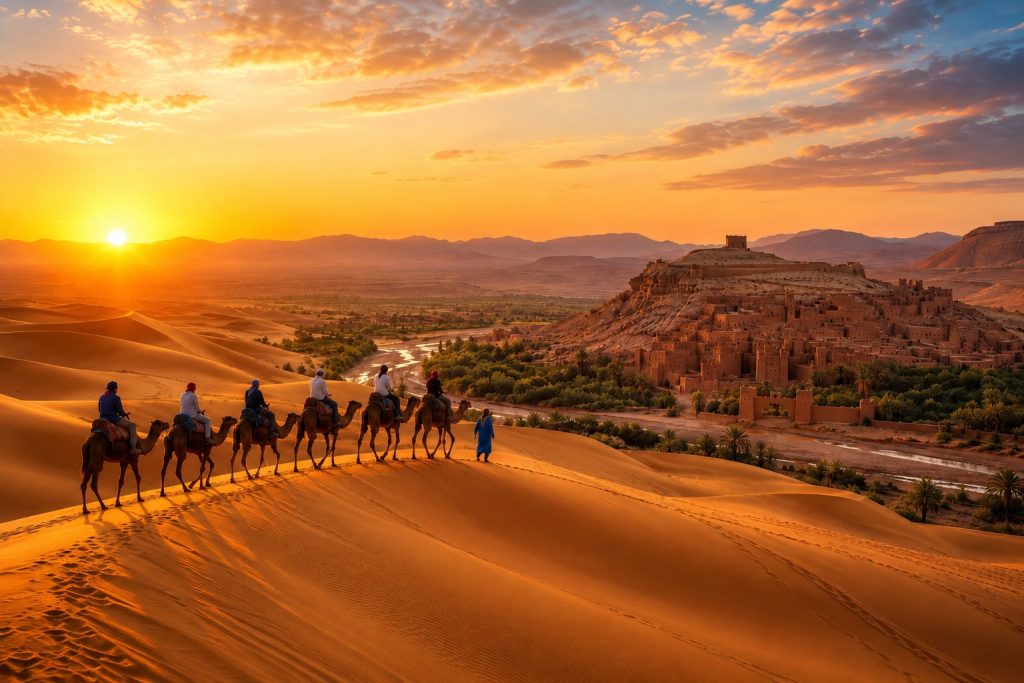
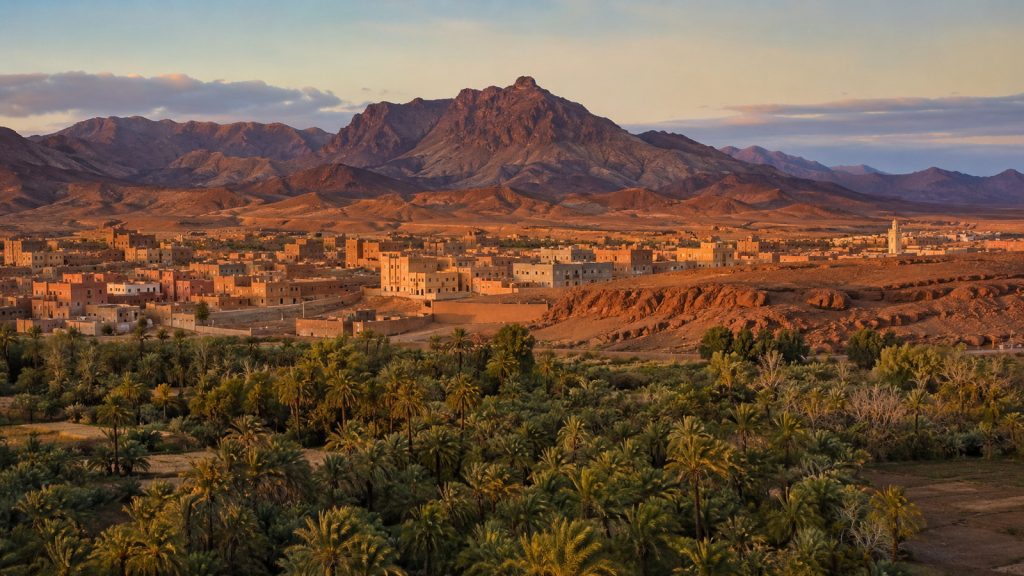
Traditional kasbahs rise above the date-palm oasis along the Draa Valley road to Zagora.
A strong Zagora Travel Guide should begin with the destination’s real character. Zagora rewards travelers who enjoy transitions: green palm groves against dry mountains, lively market streets beside quiet garden paths, and cultivated oases opening onto stony desert plateaus. It feels less polished than Morocco’s major tourist cities, which is precisely why many visitors remember it.
The town also gives context to the Draa Valley’s long history of exchange. Its well-known ‘Tombouctou 52 jours’ sign is a modern landmark that recalls the memory of trans-Saharan caravan routes rather than a surviving mileage marker from antiquity. Nearby ksour, kasbahs, workshops and irrigation landscapes reveal a region shaped by trade, agriculture and adaptation to an arid climate.
The official Moroccan tourism overview presents Zagora, Ouarzazate and Tinghir as gateways to varied valleys and desert scenery. Visit with time to walk, talk with local craftspeople and look beyond a single camel photograph.
This Zagora Travel Guide places the town in southeastern Morocco, in the Drâa-Tafilalet region along the Draa Valley south of Ouarzazate. By road it is roughly 350 km from Marrakech and about 160 km from Ouarzazate. Journey times vary with mountain traffic, weather, roadworks and stops; allow a full travel day from Marrakech rather than treating the route as a simple transfer.
The classic approach crosses the High Atlas, passes Ouarzazate and descends through the Anti-Atlas toward Agdz before following the Draa Valley south. Palm groves, kasbahs and ochre villages make the drive part of the experience. Shade Explore’s 5-day desert tour from Marrakech shows how Zagora can fit into a broader southern circuit without rushing every stop.

Zagora location and access map showing the main routes from Marrakech, Ouarzazate and Agadir to the gateway of the Sahara.
This Zagora Travel Guide separates three landscapes that tour descriptions sometimes group under the phrase ‘Zagora desert.’ Understanding the difference prevents disappointment and helps you choose the right itinerary.
Around the town, expect palm groves, dry river landscapes, dark mountain ridges and hamada—wide, stony desert plains. These views are dramatic and unmistakably pre-Saharan, but they are not an endless sea of high sand dunes.
Tinfou is a small, isolated dune area south of Zagora and near Tamegroute. It is useful for a short sunset stop, a brief camel experience or a first introduction to sand. It should not be marketed as equivalent to Erg Chigaga or Erg Chebbi.

The Tinfou dune offers a first desert experience a short drive from Zagora.
Erg Chigaga is a remote dune system reached beyond M’Hamid El Ghizlane, usually by guided 4×4 or as part of a trek. The off-road journey, desert camp, sunset and night sky create the region’s most immersive Sahara experience. The official tourism site also distinguishes the Draa Valley, Tinfou and Chigaga landscapes.
Choose Zagora for the Draa Valley, Tamegroute, caravan-route atmosphere and access to remote Erg Chigaga. Choose Merzouga when your priority is reaching high, photogenic Erg Chebbi dunes directly from a village with more developed desert infrastructure. Both are rewarding, but they are not interchangeable.
The best things to do in Zagora combine the town, nearby oasis settlements and one carefully chosen desert experience. This Zagora Travel Guide recommends building variety into the schedule instead of spending every hour in a vehicle.
Walk with a local guide through date-palm gardens and small agricultural plots to understand how shade, water channels and layered planting sustain life in the oasis. Paths can be confusing and cross private working land, so local guidance improves both access and etiquette. Early morning and late afternoon offer softer temperatures and better light.
The painted sign at the entrance to Zagora has become the town’s best-known photo stop. Treat it as a symbolic reference to the long caravan journey toward Timbuktu. A quick picture is enough; the deeper story appears in the valley’s trade routes, settlements and cultural memory.
Amezrou, near Zagora, is associated with an old Jewish quarter and a tradition of metalwork and jewellery. Visit respectfully with someone who can explain the neighbourhood’s layered history. Ask before photographing residents or workshops, and let craftspeople describe the materials and techniques rather than assuming that every object is antique or locally made.
Tissergate is a compact earthen settlement in the palm-grove landscape north of Zagora. Its shaded passages and defensive form help visitors understand pre-Saharan architecture on a human scale. A local museum may offer additional context when open; verify access and hours on the day of your visit.
The large weekly market is one of the best places to see the region’s everyday economy, from dates and vegetables to household goods, livestock areas and desert clothing. Wednesday and Sunday are commonly cited market days, but schedules and locations can change. Confirm locally, arrive in the morning and keep photography discreet.
Tamegroute is known for the historic Nasiriyya religious and learning complex, its manuscript tradition and distinctive green-glazed pottery. Access to religious spaces or collections may be limited, and opening patterns can change. Dress respectfully and follow local instructions. The official Moroccan tourism culture page provides useful background on the region’s earthen heritage and Tamegroute library.
At the pottery workshops, look for the full process—from clay preparation and wheel work to glazing and firing. Buying directly from a transparent workshop supports local knowledge, but ask whether the piece is food-safe if you intend to use it for cooking or serving.

Tamegroute is renowned for its distinctive green-glazed pottery, handmade in local family workshops.
Tinfou works best as a short landscape stop, especially when combined with Tamegroute. The warm light can be beautiful, but set expectations correctly: this is a small dune feature surrounded by rocky terrain, not a substitute for a multi-day Sahara expedition.
The road south to M’Hamid reveals increasingly arid scenery and settlements shaped by the desert frontier. M’Hamid is a practical departure point for Erg Chigaga. Use a reputable operator for the off-road section, carry sufficient water and avoid attempting remote tracks in an ordinary rental car.
A well-planned camp stay can include a 4×4 transfer, sunset walk, dinner, music, stargazing and sunrise. Ask exactly where the camp is located, how long the off-road transfer takes and what ‘luxury’ includes. Private bathrooms, heating, electricity and mobile coverage vary widely. Choose a camp that manages water, waste and generator use responsibly.

An excursion from Zagora through M’Hamid leads to the remote dunes and desert camps of Erg Chigaga.
The dark ridge above the oasis creates a striking backdrop at sunrise and sunset. Viewpoint access and trail conditions can vary, so ask a local guide or accommodation for the safest current option. Carry water and avoid exposed walks during the hottest part of the day.
This Zagora Travel Guide treats a desert tour as a choice, not a single standard product: it can be as simple as a sunset near Tinfou or as ambitious as several nights crossing remote terrain. Match the experience to your available time, mobility and tolerance for long drives.
Zagora is often introduced through the image of a caravan leaving for Timbuktu, but its cultural identity is broader than one famous sign. The town sits within a chain of oasis settlements where agriculture, trade, religious learning and mobility have shaped daily life for generations. Understanding that context turns a scenic stop into a more meaningful visit.
The Draa corridor connected communities on both sides of the mountains and farther south. Dates, salt, textiles, animals, metalwork and knowledge moved through the region, while fortified villages protected families, stores and water systems. Modern roads have transformed travel, yet the memory of movement remains visible in place names, markets, architecture and family histories.
The ‘Tombouctou 52 jours’ sign is best read as a symbol of Zagora’s caravan memory. It evokes the immense distance between the Draa Valley and the Sahel, but it should not be treated as a precise contemporary itinerary or an unchanged historical road marker. Caravan travel varied with water, weather, security and the animals carrying the loads.
A responsible guide uses the sign to open a conversation about exchange rather than presenting the past as an exotic adventure. Ask how routes affected settlement patterns, languages and crafts, and remember that trans-Saharan trade included difficult histories as well as commercial and cultural connections.
Throughout the valley, compact ksour and fortified kasbahs were built with earth, timber and local stone. Thick walls moderate temperature, covered lanes create shade and dense construction protects limited agricultural land. Tissergate is one of the most accessible places near Zagora to observe these principles, but it remains a lived environment rather than an outdoor film set.
Rain, changing lifestyles and maintenance costs make earthen heritage vulnerable. Use marked routes, do not climb unstable walls and pay local entry or guiding fees when requested. The official regional tourism description of Ksar Tissergate provides useful background before a visit.
Tamegroute’s significance comes from religious scholarship, manuscript culture and the Nasiriyya tradition as well as pottery. Not every room or collection is continuously open to casual visitors, and access can change around religious events. Modest clothing, quiet behaviour and a local guide help visitors approach the site appropriately.
The village’s ceramic workshops add a living craft dimension. The characteristic glazes vary in tone and texture because pieces are made and fired by hand. Rather than searching for identical souvenirs, look for evidence of the process and ask how the workshop organizes production, pricing and shipping.
The Draa Valley cannot be reduced to a single cultural label. Amazigh heritage, Arabic-speaking communities, Saharan connections, religious lineages and the memory of Jewish neighbourhoods all contribute to the region. Identities are lived and evolving, not museum categories.
Listen to the terms people use for themselves, avoid intrusive questions and do not photograph children or private homes without clear permission. A thoughtful local guide can explain language, clothing, food and architecture while avoiding stereotypes.
The green ribbon visible around Zagora is not a natural garden requiring no work. It is a carefully managed oasis landscape where water, shade and soil have been organized under arid conditions. Walking through it with local context is one of the most valuable experiences in this Zagora Travel Guide.
Palm groves also face pressure from drought, changing water availability, plant disease, rural migration and land fragmentation. Visitors can support the landscape by staying on paths, avoiding waste and choosing guides or lodges that work with local communities.

Traditional kasbahs rise above the date-palm oasis along the Draa Valley road to Zagora.
Date palms form the upper canopy. Fruit trees and smaller crops can grow beneath them, where reduced sun and wind slow evaporation. The exact pattern varies from garden to garden, but the layered system explains why a narrow cultivated corridor can remain productive beside barren-looking mountains.
The most photogenic viewpoint is not always the most informative. A guided walk can reveal irrigation channels, field boundaries, drying dates, composting practices and the seasonal work that sustains the grove.
Channels and wells are part of an active agricultural system. Do not wash in them, block them for photographs or assume every path is public. Water scarcity is a practical reality, so showers, swimming pools and camp services should be used with restraint even when a hotel advertises abundant comfort.
Travelers can refill a reusable bottle with treated water supplied by their accommodation and avoid leaving single-use plastic at remote stops. Ask camps how drinking water and wastewater are managed rather than judging sustainability only by décor.
Dates are an important food and source of income across the valley. Varieties differ in colour, texture, sweetness and storage quality. When buying at the souk, ask for a small taste, compare grades and confirm the price by weight before ordering a large quantity.
Harvest timing varies, and a visit outside the main season can still be rewarding. Markets, gardens and kitchens show how dates are stored, served with tea and incorporated into everyday hospitality throughout the year.
Wear closed footwear, carry water and follow a guide who knows which paths are appropriate. Palm groves can contain irrigation ditches, uneven surfaces, insects and working animals. After rain, some paths become muddy even when the surrounding desert appears dry.
Keep groups small, lower voices near homes and avoid drones unless all legal and local permissions are clear. Purchasing dates, pottery or guiding services directly can create more local value than a hurried roadside photo stop.
Zagora offers strong photographic contrasts: palms against dark ridges, geometric adobe walls, market colours and long desert shadows. The best images come from accurate planning and respectful access rather than inventing scenes or placing people into staged ‘nomad’ roles.
Dust and heat affect equipment. Carry a sealed bag, lens cloth and spare battery, and change lenses indoors or inside a vehicle when wind is strong. A simple prime or standard zoom is often more practical than a heavy kit during walks and transfers.
Morning light can reveal texture in the palm grove and villages, while late afternoon warms earthen walls and mountain faces. Midday light is harsh but can work inside shaded passages at Tissergate or for graphic patterns in pottery workshops.
Use viewpoints and established paths instead of walking into agricultural plots. If a terrace belongs to a café, lodge or family, ask before setting up equipment and buy something when appropriate.
Religious sites may prohibit photography in certain spaces. Put the camera away immediately when asked. In workshops, obtain permission from the artisan before photographing faces or close-up work, and make a purchase or pay an agreed photography fee if that is the local practice.
A sequence showing clay, hands, glazing, kiln and finished ceramics tells a stronger story than a single shelf of products. Keep captions factual and do not label every green vessel as ancient.
At Tinfou, compose honestly so the image does not suggest an enormous erg. At Erg Chigaga, dunes provide wider horizons and cleaner layers, but wind can erase tracks and reduce visibility quickly. Follow the guide’s return time and carry a headlamp after sunset.
For stars, use a stable support, a wide lens and a dim red light. Avoid shining bright phones or torches into other guests’ exposures. Moon phase, clouds, dust and camp lighting determine what is possible, so no operator can guarantee a perfect Milky Way photograph.
Always ask before photographing identifiable people. A friendly conversation does not automatically equal consent to publish an image commercially. Children require permission from a responsible adult, and a refusal should end the discussion without pressure.
Drone rules in Morocco are restrictive and equipment can create legal or privacy problems. Do not arrive expecting to fly. Verify current national requirements through official channels well before travel and respect any local restrictions even when an online photograph suggests that others have flown there.
The same itinerary does not work for every traveler. Road time, temperature, camp access and walking surfaces should be adjusted before booking. A private journey is especially useful around Zagora because it can balance cultural stops with rest rather than forcing everyone into one desert template.
Choose a quiet palm-grove lodge, private driver and small camp with a clearly described room category. A private dinner or sunset walk is more reliable than asking for vague ‘romantic decoration.’ Confirm whether the camp is secluded or part of a large cluster before paying a premium.
Two nights in the region reduce fatigue and allow one slow morning. Combine Zagora with Aït Ben Haddou or Ouarzazate rather than spending consecutive days returning over the same mountain road.
Break the Marrakech drive with an overnight stop and schedule outdoor activities early or late. Ask for age-appropriate child restraints, shade, flexible meals and rooms close together. Short camel rides and a 4×4 camp transfer are often easier than a long trek.
Children should not wander near irrigation channels, unstable earthen walls or dunes without supervision. Carry familiar snacks, oral rehydration supplies and any essential medication because choices narrow south of Ouarzazate.
Zagora is generally relaxed, and solo visitors can stay in a central riad or join a reputable small-group excursion. Arrange late transfers in advance, share the remote-camp itinerary with someone and keep control of identification and money.
Joining the cheapest street offer is not the only way to meet people. A guided palm-grove walk, pottery visit or established camp can provide social contact with clearer safety and service standards.
Earthen villages, palm-grove paths and sand are uneven, and many riads have stairs without elevators. Ask for exact information: number of steps, bathroom layout, distance from vehicle to room and whether staff can safely assist. ‘Accessible’ can mean very different things.
A 4×4 sunset viewpoint, ground-floor lodge room and visits to open workshop areas may replace long walks or camel rides. Discuss mobility needs privately and in detail before confirming the itinerary.
Zagora can suit different budgets, but the lowest advertised price often excludes the remote transfer, camp category, meals or private guiding that defines the experience. Compare complete itineraries and written inclusions rather than daily prices alone.
The main variables are private versus shared transport, vehicle type, number of travelers, accommodation standard, camp location, length of the off-road transfer, meals, local guides and whether the trip returns to Marrakech or continues elsewhere. Erg Chigaga usually costs more than a Tinfou stop because it requires more time, fuel and specialized access.
Request a quote that names every night and major activity. Confirm taxes, drinks, lunches, gratuities and single-room supplements. A transparent operator should also explain cancellation terms and the alternative plan if weather affects the tracks.
Carry Moroccan dirhams for souks, tips, simple cafés and small workshops. ATMs are available in Zagora, but a machine can be offline or unable to serve a foreign card. Withdraw before leaving for M’Hamid or a remote camp and keep small notes separate from your main wallet.
Cards are more common at larger hotels than in villages. Never rely on a camp to process a last-minute balance without confirming the method in writing.
Coverage is generally easier in town than on the tracks, and a camp’s Wi-Fi may depend on a mobile signal or generator. Download maps, reservation details and contact numbers before leaving Zagora. A local SIM can be useful, but no provider covers every remote area.
Tell family that you may be offline overnight. A professional desert operator should have its own communication and contingency procedures rather than relying on a guest’s phone.
Arabic and Amazigh languages are part of daily life, while French is widely useful in tourism and some guides speak English or Spanish. A greeting, thanks and patient tone matter more than perfect vocabulary. Ask before entering workspaces or homes.
Dress is a personal choice, but light, modest clothing is practical for sun and cultural settings. Public affection should be discreet, and visitors should avoid treating traditional dress as a costume prop.
Tips are customary for good service but should reflect the length and quality of the work. Ask your operator whether guides, drivers and camp staff are tipped separately. Carry small notes and give directly rather than assuming a group collection reaches everyone.
In shops, polite negotiation may be expected, but not every price is flexible. Compare quality, ask about origin and decline calmly. For pottery, request secure packing and discuss shipping risk before purchasing large pieces.
This Zagora Travel Guide favors spring and autumn for balanced temperatures, but each season changes the experience. Read Shade Explore’s complete Best Time to Visit Morocco guide when combining Zagora with mountain, coastal or northern destinations.
Spring is generally comfortable for palm-grove walks, village visits and camping. Daytime heat increases toward late May, while wind can occasionally carry dust or sand. Easter and holiday periods may be busier, so reserve preferred camps in advance.
Autumn brings more comfortable conditions after the summer heat. Date harvest activity can add interest in parts of the Draa Valley. October and November are popular for desert trips, making early booking sensible for small, quality properties.
Winter days can be sunny and pleasant, but nights in the desert may feel very cold. Pack a warm layer, hat and sleepwear, and ask whether the camp provides adequate bedding or heating. Short daylight hours also affect driving plans.
Summer heat can be extreme. If travel is unavoidable, schedule activity near sunrise or late afternoon, stay in air-conditioned accommodation and avoid exposed walks at midday. Confirm that any camp or vehicle is properly equipped for the season.
A realistic Zagora itinerary depends on whether you want the town and nearby sights or a remote desert journey. One night is a transit stop; two nights provide a meaningful introduction; three or more are preferable when Erg Chigaga is included.
The journey is a central part of any Zagora Travel Guide because road conditions and stop choices shape the day. Zagora has regional transport, but a private transfer or organized tour is easiest when you want to explore villages, viewpoints and desert tracks rather than simply reach the bus station.
Most road itineraries cross the Tizi n’Tichka route, pass Ouarzazate and continue through Agdz and the Draa Valley. Do not plan a same-day return. A minimum two-day trip is possible but drive-heavy; three to five days creates a better balance of travel and discovery.
Ouarzazate is the most convenient major starting point. The route via Agdz is scenic and can include kasbah or palm-grove stops. Travelers approaching from Marrakech may also visit the UNESCO-listed ksar using our Ait Ben Haddou Travel Guide and the official UNESCO site record.
Buses and shared taxis can reduce costs, but timetables, departure points and luggage rules should be verified locally. A private driver costs more but allows scenic stops, hotel pickup and safer coordination with a remote camp transfer. Self-driving works for the paved route; never take a standard rental vehicle onto deep desert tracks unless the contract and conditions explicitly allow it.
Where you stay changes the rhythm of the trip. This Zagora Travel Guide recommends choosing an area before choosing a hotel category, then checking recent reviews for cleanliness, air-conditioning or heating, parking and meal quality.
Best for travelers using public transport, visiting the souk or wanting restaurants and practical services nearby. Expect more road activity than in the palm-grove areas.
Riads and lodges around Amezrou can feel calmer and more atmospheric. Confirm access if arriving after dark and ask whether the property can arrange a guided walk through the gardens.
Stay farther south when pottery, village life or an early Erg Chigaga departure is the priority. M’Hamid reduces the paved-road portion before the off-road desert transfer.
Ask for the exact camp location—not only the word ‘Zagora.’ Clarify whether the camp is near Tinfou, around M’Hamid or at Erg Chigaga, because the scenery, transfer time and level of remoteness differ substantially.
This Zagora Travel Guide also makes room for food, because meals in the Draa Valley are an opportunity to experience southern Moroccan hospitality at an unhurried pace. Look for seasonal, freshly prepared dishes and remember that remote camps usually offer a set menu rather than restaurant-style choice.
A practical Zagora Travel Guide must account for strong sun, dust, large temperature changes and limited shopping once a remote excursion begins. Pack light, but do not omit layers or essential medication.
This Zagora Travel Guide is designed for informed planning: the town is generally calm for visitors, but desert conditions and long-distance driving require preparation. Review Shade Explore’s Morocco Travel Tips before departure and share any mobility, medical or dietary requirements with the operator in advance.
This Zagora Travel Guide recommends a flowing southern route rather than a hurried out-and-back drive. The following combinations reduce repetition and add meaningful contrasts.
Allow at least three days, and preferably four or five, to cross the Atlas, visit key heritage stops and spend time in the valley. The 5-day Merzouga and Zagora desert tour is designed for travelers who want both major southern regions in one private journey.
Plan one night around Zagora, one or two nights in or beyond M’Hamid and enough time for a safe off-road return. This is the strongest choice when remote desert atmosphere matters more than covering many cities.
Travelers with more time can place Zagora between the Dades–Ouarzazate region and the Anti-Atlas, Taroudant or the Atlantic coast. Shade Explore’s 24 Days Morocco Tour provides a complete north-to-south example.
Yes. This Zagora Travel Guide especially recommends the destination for travelers interested in the Draa Valley, oasis agriculture, Tamegroute pottery, earthen settlements and remote desert routes. Zagora is less about one monumental sight and more about landscape, cultural context and the journey south.
Zagora sits at the edge of pre-Saharan landscapes and serves as a gateway toward the Sahara. Around town you will see palm groves, mountains and stony desert plains. The large Erg Chigaga dunes are farther south beyond M’Hamid and normally require guided off-road access.
Neither is universally better. Zagora is ideal for the Draa Valley, Tamegroute and remote Erg Chigaga expeditions. Merzouga provides direct access to the high Erg Chebbi dunes and more developed desert accommodation. Choose according to route, time and preferred scenery.
Two nights are recommended for Zagora, the palm groves, Tissergate, Tamegroute and Tinfou. Add at least one more night if you want to reach Erg Chigaga without turning the experience into a rushed transfer.
Spring from March to May and autumn from September to November usually offer the most comfortable balance. Winter days can be pleasant but desert nights are cold. Summer may be extremely hot and requires a heat-adapted schedule.
The road distance is roughly 350 km. The drive commonly takes 6.5–8 hours before long sightseeing stops, depending on High Atlas traffic, weather and road conditions. Treat the journey as a full travel day.
Yes, but a two-day return trip involves many hours of driving and only a short stay. Three or more days gives you a better experience of the Draa Valley; four or five days works better when combining Zagora with other southern destinations.
Yes. Tamegroute adds cultural depth through its pottery tradition, earthen village setting and historic religious-learning complex. Access to the library or religious spaces can vary, so visit respectfully and verify arrangements locally.
No. Tinfou is a small isolated dune area that works well for a short stop. Erg Chigaga is a much larger, remote dune system reached beyond M’Hamid by guided 4×4 or trek.
No. Camel rides are optional, and a reputable operator should never pressure you. Many camps can be reached by 4×4, which may be more suitable for young children, older visitors or travelers with back, hip or mobility concerns.
Yes, but the label covers very different locations and facilities. Ask whether the camp is near Tinfou, M’Hamid or Erg Chigaga, and confirm the transfer time, private bathroom, bedding, heating, electricity and meal arrangements before booking.
Yes, with sensible planning. Break up the drive, avoid midday heat, choose short activities and request appropriate child restraints. A lodge with a garden or pool can balance road time, while a 4×4 transfer may be easier than a long camel ride.
Zagora is generally calm, but use normal precautions and book remote excursions with a reputable guide. Share your itinerary, avoid isolated tracks alone, keep valuables secure and arrange transport before late arrivals.
The packing advice in this Zagora Travel Guide prioritizes breathable modest clothing, a warm layer, closed shoes, hat, sunglasses, sunscreen, a scarf for dust, reusable water bottle, power bank, headlamp and essential medication. In winter, add genuinely warm clothing for desert nights.
Yes. This is one of the most logical routes from Marrakech: cross the High Atlas, visit Aït Ben Haddou and Ouarzazate, follow the Draa Valley through Agdz, then stay in Zagora. Continue to M’Hamid or return on a multi-day circuit rather than attempting everything in one day.
At Morocco Shade Explore, we specialize in creating authentic, private, and tailor-made journeys across Morocco.
Our tours include:
Our most popularGuarented departures include:
We hope this Zagora Travel Guide helps you plan an unforgettable journey through southern Morocco.
Continue your adventure with our complete collection of Morocco Travel Guides.
Together, these guides will help you discover Morocco’s incredible diversity—from Imperial Cities and Roman ruins to the Atlantic coastline, the High Atlas Mountains, and the majestic Sahara Desert.
Ready to discover the timeless beauty of Zagora ?
Whether you’re planning a cultural getaway, a historical tour, or a complete journey across Morocco, Shade Explore is here to create an unforgettable travel experience tailored to your interests.
Contact our travel specialists today to start planning your personalized Morocco itinerary and discover why travelers from around the world choose Morocco Shade Explore for exceptional private tours, authentic experiences, and premium service.
This Tafraoute Travel Guide introduces one of southern Morocco’s most distinctive mountain destinations. Set among rounded granite formations in the Anti-Atlas, Tafraoute is surrounded by palm-filled valleys, Amazigh villages and walking routes that reward travellers who slow down.
The town is smaller and quieter than Morocco’s headline cities, which is precisely its strength. Days revolve around scenic drives, village encounters, local crafts and changing light on the rocks. Tafraoute also fits naturally into a private route with Taroudant and Agadir, creating a rich contrast between mountains, markets and the Atlantic coast.

Map showing Tafraoute’s real location in Morocco’s Anti-Atlas Mountains, with access routes from Agadir, Tiznit and Taroudant.
Tafraoute offers a different image of Morocco: dramatic yet intimate mountain landscapes rather than monumental medinas or vast Saharan dunes. The town sits within a region shaped by Amazigh language, agriculture, craft traditions and routes between small villages.
A well-planned Tafraoute Travel Guide should make room for the journey itself. Roads cross argan country, climb into the Anti-Atlas and reveal new rock formations at every turn. Travellers who stay overnight can experience softer morning and evening light, quieter trails and a more meaningful rhythm than a hurried return trip.
This Tafraoute Travel Guide highlights the most remarkable landscapes of the Anti-Atlas Mountains.
Learn more about Morocco’s Taroudant and cultural heritage on the official Visit Morocco website before planning your visit.
The fertile Ameln Valley spreads beneath the rugged face of Jebel Lekst. Palm groves, cultivated plots and traditional villages create one of the area’s defining panoramas. Stop at viewpoints, then spend time walking through a village with respect for homes, fields and daily life.
A natural outline in the rock face is popularly known as the Lion’s Head. The shape depends on angle and light, so a local guide can help identify the best viewpoint. Treat it as a playful landscape detail rather than a guaranteed perfect photograph.

Afternoon shadows reveal the natural Lion’s Head profile in the Jbel Lekst mountains above Tafraoute.
The centre is compact enough to explore on foot. Browse produce stalls, cafés and small shops while observing the town as a regional hub, not only a tourist stop. Morning is best for practical errands; evening brings a sociable café atmosphere.
Large boulders outside town were transformed into a land-art installation associated with Belgian artist Jean Vérame. Colours and surfaces change over time, so approach the site as an evolving artwork within a fragile desert landscape. Stay on existing tracks and take all litter away.

The famous blue-painted granite rocks near Tafraoute, one of the Anti-Atlas region’s most unusual landmarks.
The village of Aguerd Oudad is known for an unusual rock formation nicknamed Napoleon’s Hat. The surrounding lanes, houses and granite backdrop are equally rewarding. Park without blocking access and ask permission before photographing residents.

Aguerd Oudad village beneath the famous Napoleon’s Hat rock formation near Tafraoute.
Aït Mansour Gorge offers a striking transition from bare rock to a palm-lined oasis corridor. Road and water conditions can vary, especially after unusual weather. A local driver or guide helps determine safe access and prevents a scenic outing from becoming an overambitious route.

A narrow road winds between palm groves and red granite cliffs in Aït Mansour Gorge near Tafraoute.
Short walks and longer mountain routes reveal terraced fields, boulders and high viewpoints. Navigation is not always obvious, mobile coverage can be inconsistent and midday heat is deceptive. Hire a qualified local guide for remote trails or any ascent toward Jebel Lekst.
Villages around Ameln Valley and the wider Tafraoute area preserve adobe and stone architecture adapted to the climate. Some houses are private and some structures are fragile. Walk quietly, avoid entering without invitation and support local cafés, guides or cooperatives where available.
Late winter can bring delicate almond blossom to the valleys, though exact timing changes with weather and elevation. If blossom is important to your trip, keep dates flexible and ask local contacts for current conditions instead of relying on a fixed annual promise.
Tafraoute is known for distinctive leather slippers and other regional crafts. Compare quality, stitching and materials, then negotiate respectfully. Purchasing directly from a workshop or reputable local seller keeps more value within the community.
Late light turns the boulders through shades of rose, copper and violet. Choose a safe viewpoint before sunset, carry a torch for the return and avoid climbing unstable rocks simply for a photograph. The best compositions often come from simple roadside or valley viewpoints.
The fortified village of Tizourgane makes a compelling stop when travelling between the coast, Anti-Atlas and Tafraoute. Access and restoration arrangements can change, so confirm locally. Even from outside, its hilltop form helps explain how architecture responded to defence, terrain and community life.
The landscape is the main attraction, but distances and difficulty vary widely. Short village walks suit most active travellers, while remote valleys and Jebel Lekst routes require stronger fitness, navigation and local knowledge.
This Tafraoute Travel Guide recommends separating scenic driving from serious hiking. Trying to combine the Painted Rocks, Aït Mansour Gorge and a mountain trek in one day creates excessive driving and little time to understand each place.
Make this a dedicated outing rather than squeezing it between distant sights. Pause in permitted areas, respect irrigation channels and avoid leaving waste in the oasis.
This route connects mountain architecture with the gradual descent toward the Souss plain and Agadir. It works especially well as a transfer day rather than a return excursion.
Taroudant adds ramparts and souks to an Anti-Atlas itinerary. Use the Taroudant Travel Guide to decide whether to continue north through the Souss Valley or return toward Agadir.
Agadir provides beaches, wider hotel choice and onward transport. The Agadir Travel Guide helps turn the transfer into a balanced coastal stay.
Two nights are the practical minimum for most travellers: one afternoon for town and nearby rocks, one full day for Ameln Valley or Aït Mansour, and one final morning for a walk or market stop. Three nights allow both a scenic drive and a proper guided hike.
A same-day return from Agadir is possible but involves substantial road time. If your schedule allows, an overnight stay produces a calmer and more authentic experience.
Autumn through spring is generally best for walking and road trips. Winter mornings and nights can be cold in the mountains, while sunny afternoons feel warm. Late winter may coincide with almond blossom. Summer temperatures can make exposed sightseeing and hiking uncomfortable, so plan very early starts and seek local advice.
Weather in the Anti-Atlas can change quickly. Check forecasts for Tafraoute and the specific valleys you plan to visit, not only coastal Agadir.
Learn more about Morocco’s Taroudant and cultural heritage on the official Visit Morocco website before planning your visit.
Most visitors arrive by road from Agadir, Taroudant, Tiznit or another South Morocco stop. Driving time depends heavily on the chosen mountain route, roadworks and photo stops. A private driver offers the easiest balance of flexibility and local knowledge; a rental car suits confident drivers comfortable with winding roads.
Public buses and shared taxis may serve the town, but schedules and connections can change. Confirm locally before relying on a same-day connection, and avoid building a tight airport transfer around an unverified timetable.
Use this Tafraoute Travel Guide to choose the best accommodation for your stay
Expect straightforward regional cooking: tagines, couscous on traditional serving days, seasonal vegetables, bread, olives, amlou, almonds and dishes using local argan oil. Menus may be limited outside peak periods, so reserve dinner at small guesthouses and tell hosts about dietary needs in advance.
These products is selected by UNESCO Arganeraie Biosphere and Reserve make excellent souvenirs while offering a taste of the region’s agricultural heritage.
Arrive before late afternoon, settle in, walk through town and visit Aguerd Oudad or a safe granite viewpoint for sunset.
Explore valley viewpoints and one or two villages with a local guide, allow time for lunch and visit a workshop or market without turning the day into a shopping circuit.
Choose one substantial activity based on weather and fitness, then continue toward Taroudant or Agadir. Shade Explore’s 24 Days Morocco Tour demonstrates how Tafraoute fits into a complete north-to-south itinerary.
Yes. Tafraoute is worth visiting for its granite landscapes, Amazigh villages, palm valleys, walking routes and slower atmosphere. It is particularly rewarding for travellers interested in photography, hiking and regional culture.
Plan at least two nights. Three nights are better if you want both Aït Mansour Gorge and a guided hike or extended village exploration.
Autumn, winter and spring offer the most comfortable conditions for exploring. Winter nights can be cold, late winter may bring almond blossom and summer can be very hot on exposed routes.
The most flexible options are a private driver or rental car. Mountain driving time varies by route and stops. Public transport may be available, but confirm the current timetable locally before travel.
It is possible but rushed because the road journey is a major part of the day. An overnight stay gives you sunset, quieter mornings and time for more than roadside photographs.
You do not need a guide for the town and simple roadside viewpoints. Hire a qualified local guide for remote valleys, village context, long hikes or routes near Jebel Lekst.
The town is generally calm, but mountain precautions matter. Share plans, avoid remote solo hikes, carry water and layers, and use trusted transport after dark.
They are a land-art installation on large granite boulders outside town, associated with artist Jean Vérame. Visit responsibly by staying on existing tracks and leaving no waste.
Blossom often appears in late winter, but exact timing changes each year with temperature and rainfall. Ask local accommodation providers for current conditions before booking around the bloom.
Yes. Scenic drives, village walks and short paths can suit families. Choose age-appropriate routes, protect children from sun exposure and avoid unguarded climbs on boulders.
Bring walking shoes, layered clothing, sun protection, a reusable water bottle, cash, offline maps and a torch. Add trekking equipment only for routes agreed with a guide.
Yes. This is one of the strongest South Morocco combinations: Anti-Atlas scenery in Tafraoute, medina culture in Taroudant and Atlantic relaxation in Agadir. See Shade Explore’s 16-day Morocco circuit for a broader route example.
At Morocco Shade Explore, we specialize in creating authentic, private, and tailor-made journeys across Morocco.
Our tours include:
Continue your adventure with our complete collection of Morocco Travel Guides.
Together, these guides will help you discover Morocco’s incredible diversity—from Imperial Cities and Roman ruins to the Atlantic coastline, the High Atlas Mountains, and the majestic Sahara Desert.
Ready to discover the timeless beauty of Tafraoute ?
Whether you’re planning a cultural getaway, a historical tour, or a complete journey across Morocco, Shade Explore is here to create an unforgettable travel experience tailored to your interests.
Contact our travel specialists today to start planning your personalized Morocco itinerary and discover why travelers from around the world choose Morocco Shade Explore for exceptional private tours, authentic experiences, and premium service.
This Taroudant Travel Guide helps you explore an atmospheric walled city in Morocco’s fertile Souss Valley. Behind long ochre ramparts, Taroudant offers medina lanes, traditional souks, neighbourhood cafés and craft traditions without the scale or intensity of the country’s largest urban centres.
Many travellers visit from Agadir for a few hours, but staying overnight reveals a calmer evening rhythm and allows time for nearby landscapes such as Tiout Oasis. Taroudant also forms an excellent bridge between the coast and the Anti-Atlas, especially when combined with Agadir and Tafraoute.
Taroudant appeals to travellers who enjoy lived-in historic cities. The medina is not a museum: residents shop, work and socialise inside the walls. This makes ordinary moments—bread arriving at a bakery, artisans opening workshops, families gathering in a square—as valuable as individual monuments.
A useful Taroudant Travel Guide should also explain its geographic role. The city sits between the High Atlas, Anti-Atlas and Atlantic region, making it a natural stop on a South Morocco circuit. Shade Explore’s 24 Days Morocco Tour connects Taroudant with Tafraoute and Agadir as part of a much broader journey.
Learn more about Morocco’s Taroudant and cultural heritage on the official Visit Morocco website before planning your visit.

Taroudant is located in Morocco’s Souss Valley, approximately 83 km east of Agadir.
Taroudant’s ochre walls and towers define the city. Walk selected stretches in the cooler morning or late afternoon, noticing how gates connect the medina with modern neighbourhoods and the surrounding plain. Road traffic can be busy near major entrances, so choose pedestrian areas carefully.
The gates create strong views and natural orientation points. Rather than rushing between names, pause to watch the movement of bicycles, carts, taxis and pedestrians. Photograph architecture from a safe position and never block an active entrance.

A historic entrance through Taroudant’s ochre ramparts, leading into the traditional medina.
Taroudant’s medina rewards wandering at a gentle pace. Lanes alternate between shops, homes, workshops and quiet corners. Use a map for orientation but allow room for discovery; a local guide adds history and helps distinguish public spaces from private ones.

Explore the peaceful ochre streets and traditional architecture of Taroudant’s historic medina.
The markets include produce, spices, leather goods, household items, textiles and regional crafts. Some sections serve residents more than visitors, which is part of their value. Ask before taking close photographs and bargain with courtesy when prices are not fixed.

Discover the colors, local products and authentic atmosphere of Taroudant’s traditional souk.
Continue reading our Taroudante Travel Guide to discover the best attractions inside the medina.
Silver-coloured jewellery, decorative motifs, leatherwork and ceramics reflect a wider regional craft vocabulary. Quality and origin vary, so ask sellers about materials and production. Buy because you value the object, not because a demonstration creates pressure.
This central square is a practical place to pause with tea or coffee and watch local life. The atmosphere changes through the day, becoming more animated toward evening. Choose a café with clear prices and keep walkways open for residents.
A horse-drawn carriage can provide an easy overview when operated responsibly. Agree on the route, duration and price before departure, and choose animals that appear well cared for. A private vehicle or bicycle is an alternative for a longer circuit.
Look for tagines, grilled meats, seasonal vegetables, olives, bread, citrus and amlou. Smaller restaurants may have limited menus, which often means dishes are prepared around what is fresh. Tell the kitchen about allergies or vegetarian needs before ordering.
An overnight riad stay changes the experience from excursion to destination. Courtyards offer shade after a medina walk, and local hosts can recommend current restaurants, workshops and market times. Choose a property with clear access instructions if arriving by car.
Tiout offers palm groves, village scenery and views toward a historic kasbah setting. Irrigation channels and agricultural paths are working infrastructure, so follow local guidance and avoid damaging crops. A community guide can explain water, farming and landscape more accurately than a hurried photo stop.
The wider Souss region belongs to Morocco’s argan country. Visit a transparent cooperative or community initiative to learn how fruit is collected and oil produced. Responsible purchasing should support quality, fair labour and genuine local value.

Goats climbing among the branches of an argan tree in Morocco’s Souss region.

Ancient argan trees spread across the semi-arid landscapes surrounding Taroudant in the Souss Valley.
Late light intensifies the walls’ warm colour and silhouettes palms beyond the city. Select a safe, permitted viewpoint and be considerate around homes. Sunset is also a good transition into an evening meal and a second walk through the centre.

A traditional calèche follows the scenic road alongside Taroudant’s historic fortified walls.
Taroudant is often compared with Marrakech because of its walls and markets, but the experience is smaller and more locally paced. There are fewer headline monuments, so the pleasure comes from observation, conversation and details of everyday trade.
This Taroudant Travel Guide recommends entering with a purpose—perhaps spices, leatherwork or jewellery—then allowing time for unplanned discoveries. If you are not buying, a polite “no thank you” is enough. If you negotiate, do so only when genuinely interested.
This Taroudante Travel Guide also explains how to reach the city from Agadir and Marrakech.
The closest classic excursion combines palm landscapes, village life and a kasbah viewpoint. Half a day may be enough, but a slower visit with a local guide provides more context.
Tafraoute’s granite scenery and Amazigh villages contrast strongly with the Souss plain. The road deserves an overnight plan; use the Tafraoute Travel Guide to build the next stage.
Agadir adds Atlantic beaches, a modern city and an international gateway. Read the Agadir Travel Guide for beach, neighbourhood and day-trip planning.
Travellers continuing east can explore saffron country and routes toward Ouarzazate. Distances are significant, so treat this as a transfer or overnight journey rather than a casual return trip.
One full day is enough for the ramparts, medina, souks and relaxed café time. Stay one night to experience sunset and evening life without watching the clock. Two nights are ideal if you add Tiout Oasis or want time with a guide and artisan visits.
A day trip from Agadir remains worthwhile, but avoid packing Tiout, the entire medina and multiple shopping stops into a few rushed hours.
Autumn through spring is generally most comfortable for walking. Winter days can be pleasantly mild while nights feel cool. Spring brings greener landscapes and blossoms in parts of the Souss region. Summer heat can be intense, so schedule medina walks early and rest through the hottest hours.
Religious holidays and local events can affect opening patterns. Treat those periods as cultural context, not inconvenience, and confirm any essential visit in advance.
Learn more about Morocco’s Taroudant and cultural heritage on the official Visit Morocco website before planning your visit.
Use this Taroudante Travel Guide to choose the best time of year for your visit.
Taroudant is most commonly reached by road from Agadir, whose airport and coast make it the main gateway. Private transfers offer door-to-door convenience, while buses and shared taxis may suit flexible travellers. Always verify current departure points and schedules locally.
Road travel from Marrakech or the Anti-Atlas takes longer and is best integrated into a multi-day route. If driving, plan fuel, daylight and accommodation rather than relying on optimistic map estimates.
Try seasonal tagines, couscous, olives, citrus, amlou, local honey and dishes prepared with argan oil. For purchases, consider spices, leather, ceramics, baskets and jewellery after asking about materials and origin. Avoid products made from protected wildlife or undocumented antiquities.
These products is selected by UNESCO Arganeraie Biosphere and Reserve make excellent souvenirs while offering a taste of the region’s agricultural heritage.
Arrive in the morning, walk a section of the walls, explore the souks, eat lunch in the centre, rest during the hottest hours and return for Place Assarag and sunset.
Spend half a day at Tiout with a local guide, then continue toward Agadir or stay a second night. For a longer southern route, Shade Explore’s 16-day Morocco circuit links Taroudant with Tafraoute and Agadir.
Yes. Taroudant is worth visiting for its ochre ramparts, lived-in medina, traditional souks and relaxed atmosphere. It is an excellent cultural stop between Agadir, the Anti-Atlas and inland South Morocco.
One full day covers the main city experience. One or two nights are better for sunset, evening life and an excursion to Tiout Oasis.
Autumn through spring offers the most comfortable walking weather. Winter nights can be cool, and summer sightseeing should be concentrated in the morning and late afternoon.
Taroudant is a straightforward road trip from Agadir, commonly used as a day excursion or transfer. Exact driving time depends on traffic, pickup point and stops, so confirm the current estimate for your route.
Yes. A private or organised day trip can include the ramparts, medina and souks. Add Tiout only if the schedule remains comfortable and you still have time to walk rather than view everything from a vehicle.
No. Taroudant is sometimes nicknamed “Little Marrakech,” but it is a separate, smaller city with its own Souss Valley identity, pace and market life.
Taroudant is generally calm for visitors. Use ordinary precautions: protect belongings in busy souks, use recognised transport, avoid isolated areas late at night and confirm prices before services.
You can explore the centre independently, but a licensed local guide adds historical context, helps navigate craft areas and can arrange a more meaningful Tiout visit.
Common choices include spices, leather goods, baskets, ceramics, jewellery, amlou and argan products. Ask about materials and origin, compare quality and negotiate respectfully when prices are not fixed.
Yes. The compact medina, carriage circuits and short walks can work well for families. Avoid midday heat, supervise children near traffic and choose a child-friendly pace at Tiout.
Yes. Buses, shared taxis and private transfers may connect Taroudant with Agadir and other cities. Schedules and stations can change, so verify them locally before the travel day.
Yes. This combination creates a well-balanced South Morocco route: medina and souks in Taroudant, Anti-Atlas landscapes in Tafraoute and beaches in Agadir. Shade Explore’s South Morocco tour is a useful itinerary reference.
At Morocco Shade Explore, we specialize in creating authentic, private, and tailor-made journeys across Morocco.
Our tours include:
Our most popularGuarented departures include:
We hope this Taroudante Travel Guide helps you plan an unforgettable journey through southern Morocco.
Continue your adventure with our complete collection of Morocco Travel Guides.
Together, these guides will help you discover Morocco’s incredible diversity—from Imperial Cities and Roman ruins to the Atlantic coastline, the High Atlas Mountains, and the majestic Sahara Desert.
Ready to discover the timeless beauty of Taroudant ?
Whether you’re planning a cultural getaway, a historical tour, or a complete journey across Morocco, Shade Explore is here to create an unforgettable travel experience tailored to your interests.
Contact our travel specialists today to start planning your personalized Morocco itinerary and discover why travelers from around the world choose Morocco Shade Explore for exceptional private tours, authentic experiences, and premium service.
This Agadir Travel Guide brings together everything a first-time visitor needs to plan a relaxed and rewarding stay on Morocco’s Atlantic coast. Agadir is known for its broad sandy beach and sunny resort atmosphere, yet the city also opens the door to Amazigh culture, lively markets, fishing villages, argan landscapes and the foothills of the Anti-Atlas.
Rebuilt with a modern layout after the 1960 earthquake, Agadir feels different from Morocco’s old imperial cities. Its appeal lies in easy days by the ocean, sunset viewpoints, excellent seafood and convenient excursions. Use this guide to choose what to see, how long to stay, where to base yourself and how to combine the city with Taroudant, Tafraoute or Essaouira.
Agadir works especially well for travellers who want a comfortable coastal base without giving up access to local culture and nature. The beach is the headline attraction, but the city’s real strength is variety: one morning can be spent in a colourful souk, the afternoon beside the Atlantic and the evening above the bay at Agadir Oufella.
This Agadir Travel Guide also suits travellers building a longer route through southwestern Morocco. The city has good tourism infrastructure and is a practical link between the Atlantic coast, the Souss Valley and the Anti-Atlas. Shade Explore’s 24 Days Morocco Grand Tour shows how Agadir can fit naturally into a wider journey from the imperial cities to the Sahara and South Morocco.
Learn more about Morocco’s Agadir–Taghazout and cultural heritage on the official Visit Morocco website before planning your visit.

Agadir’s real location on Morocco’s Atlantic coast, with main access routes, nearby cities and essential travel information.
The following experiences balance the city’s essential landmarks with local life, ocean scenery and nearby landscapes.
Learn more about Morocco’s Agadir–Taghazout and cultural heritage on the official Visit Morocco website before planning your visit.
Start with a gentle walk along the waterfront. The long promenade links beach cafés, hotel areas and marina views, making it an easy introduction to the city. Early morning is calm and local; late afternoon brings cooler air and a lively sunset atmosphere.

Agadir’s palm-lined corniche stretches alongside its long sandy beach, with Agadir Oufella overlooking the bay.
Agadir’s sheltered bay and broad strand make the main beach convenient for swimming, sunbathing and family time. Conditions can change with the Atlantic, so follow local flags and lifeguard guidance rather than assuming the sea is always calm.
The hilltop kasbah site overlooks the modern city, port and sweeping curve of the bay. Visit near sunset for warm light, allow time to appreciate the memorial character of the site, and avoid standing in vehicle areas while taking photographs.

Agadir Oufella lights up after sunset, overlooking the beachfront and the illuminated city.
Souk El Had is one of the city’s best places to understand everyday commerce. Wander through sections devoted to spices, olives, household goods, textiles, leather and fresh produce. Bargaining is normal for many non-food items, but it should remain friendly and unhurried.

Spices, dried goods and local crafts fill the lively aisles of Souk El Had in Agadir.
This reconstructed medina south of the centre showcases traditional architectural techniques, carved wood, stonework and craft spaces. It is not the pre-earthquake old city, so present it accurately as a contemporary cultural project inspired by Moroccan building traditions.
Agadir is a major gateway to the Amazigh regions of the Souss and Anti-Atlas. Look for exhibitions, jewellery, carpets, music and local design that explain the area’s living heritage. A respectful guide can add valuable context beyond decorative displays.
Talborjt offers a more local urban rhythm than the beachfront. Its cafés, small restaurants and neighbourhood shops are good for an inexpensive lunch or evening walk. Dress and behave as you would in any lived-in residential district rather than treating it as a staged attraction.
The marina is polished and modern, with cafés and views toward the fishing harbour. Access around working port areas may be controlled, but the district still offers an interesting contrast between leisure boats, commercial fishing and the Atlantic waterfront.
Grilled sardines, sole, calamari and seafood tagines are natural choices in Agadir. Ask about the price before ordering by weight and choose busy, clean restaurants. Pair seafood with Moroccan salads and seasonal fruit for a simple local meal.
North of Agadir, Taghazout is known for surf culture, ocean-view cafés and a compact village setting. Beginners should book a qualified instructor and use equipment suited to their level; experienced surfers should still ask local advice about currents, rocks and seasonal conditions.
Tamraght provides a quieter alternative to central Taghazout, with guesthouses, yoga spaces and access to nearby beaches. It is a useful lunch or overnight stop if you prefer a village base while keeping Agadir within reach.
The palm-lined valley inland from the coast is popular for walking and natural scenery. Water levels vary significantly, and online photographs may not reflect current conditions. Wear sturdy shoes, carry water and avoid jumping into pools unless local safety conditions are clearly confirmed.
South of Agadir, protected coastal and estuary habitats support important birdlife and contrasting landscapes. A guided nature visit is the best way to identify species, respect restricted areas and understand conservation priorities without disturbing wildlife.
The wider region lies within the argan landscape of southwestern Morocco. Visit a reputable cooperative where the process, labour and pricing are explained transparently. Buy only if you want the product; a genuine educational stop should never depend on pressure to purchase.
These products is selected by UNESCO Arganeraie Biosphere and Reserve make excellent souvenirs while offering a taste of the region’s agricultural heritage.
End a day from the beach, promenade or Oufella viewpoint. Winter skies can be particularly clear, while summer often brings a softer ocean haze. Arrive early, keep valuables secure and let the changing light—not a rushed checklist—be the experience.
A useful Agadir Travel Guide should distinguish between convenient city beaches and more exposed surf locations.

Agadir’s city, marina and sweeping Atlantic bay viewed from Agadir Oufella.
Travel inland to ochre ramparts, traditional souks and a slower medina atmosphere. Read the full Taroudant Travel Guide before deciding between a day trip and an overnight stay.
A longer scenic excursion reveals granite formations, Ameln Valley villages and distinctive Anti-Atlas landscapes. The route deserves an early departure or, ideally, an overnight plan using the Tafraoute Travel Guide.
Combine coastal villages with an inland valley only if the schedule allows unhurried stops. A private driver makes it easier to adapt to weather, traffic and current water conditions.
Choose a conservation-minded guide for estuary, steppe and coastal habitats. Wildlife sightings are never guaranteed, which is exactly why the landscape should be appreciated as an ecosystem rather than a zoo.
Essaouira is possible as a long road day, but most travellers enjoy it more as an overnight coastal extension. Compare the atmosphere and highlights in the Essaouira Travel Guide.
Two days cover the beach, promenade, Souk El Had and Agadir Oufella at a comfortable pace. Three days allow one substantial excursion, while four or five days suit travellers who want both relaxation and separate trips to Taghazout, Paradise Valley, Taroudant or Souss-Massa.
If Agadir is part of a larger itinerary, avoid treating it only as an airport stop. Even one full day creates a useful change of rhythm between the medinas, mountains and desert.
Agadir can be visited throughout the year. Spring and autumn usually offer a strong balance of warm days and comfortable sightseeing. Winter attracts travellers seeking Atlantic sunshine, although evenings can feel cool. Summer is popular for the coast, but inland excursions may be much hotter and the ocean can bring morning cloud or haze.
For a beach-focused trip, check the local marine forecast. For Anti-Atlas or Souss Valley outings, compare daytime and nighttime temperatures and carry layers.
Agadir Al Massira Airport serves the region, and road connections link the city with Marrakech, Essaouira, Taroudant and the Anti-Atlas. Confirm current flight and coach schedules directly with operators, especially outside peak periods.
Within the city, small taxis are practical for short trips and larger taxis or private transfers suit airport journeys and groups. Agree on the meter or price before departure. A rental car is useful for independent regional travel, but it is not essential for a beach-centred city stay.

A relaxing beachfront hotel pool with panoramic views of Agadir Beach and the Atlantic Ocean.
Look beyond hotel buffets for grilled fish, sardines, seafood tagines, amlou made with almonds and argan oil, local honey, Moroccan salads and seasonal citrus. Ask your host for places used by residents, verify prices on seafood sold by weight and carry cash for small eateries.
Walk the promenade, visit Souk El Had, have a seafood lunch, explore Talborjt and finish at Agadir Oufella for sunset.
Keep day one in the city. On day two, choose Taghazout and Tamraght for coast and surf, or Souss-Massa for nature and landscapes.
Add Taroudant or an overnight Anti-Atlas extension. Shade Explore’s South Morocco tour provides a useful model for connecting the Atlantic coast with Tafraoute.
Yes. Agadir is worth visiting for its broad beach, accessible resort facilities, markets, seafood and convenient day trips into the Souss Valley and Anti-Atlas. It is especially suitable for travellers who want a restful coastal stage within a wider Morocco itinerary.
Plan two days for the main city sights and beach. Allow three or four days if you want separate excursions to Taghazout, Paradise Valley, Taroudant or Souss-Massa without rushing.
Spring and autumn are excellent for mixed sightseeing and beach time. Winter is popular for mild Atlantic sunshine, while summer suits coastal holidays but can be hot on inland day trips.
Agadir is generally straightforward for visitors, but normal precautions still apply. Watch belongings in busy areas, use recognised transport, avoid isolated beaches after dark and follow local guidance for swimming and hiking.
Yes. Taxis cover city journeys, and guided excursions or private drivers reach most popular day-trip destinations. A car becomes more useful for a flexible multi-day route through the Anti-Atlas.
Yes. The beach, promenade, resort pools and short sightseeing days work well for families. Choose age-appropriate ocean activities and avoid long inland drives during the hottest part of the day.
Agadir offers more hotels, urban services and a broad resort beach. Taghazout has a smaller village atmosphere and stronger surf identity. Many travellers stay in one and visit the other.
Sea temperatures and conditions vary, and the Atlantic can be rough. Some visitors swim year-round, but always check local flags, lifeguard advice and your own comfort rather than relying only on the season.
Beachwear is normal at hotel pools and on the beach. In markets, neighbourhoods and rural day trips, choose light, comfortable clothing that covers shoulders and knees, and carry a layer for wind or cool evenings.
Cards are accepted in many hotels and larger restaurants, but cash remains useful for taxis, souks, small cafés and tips. Use official bank ATMs and keep smaller notes available.
Popular choices include Taghazout and Tamraght, Paradise Valley, Taroudant, Souss-Massa landscapes and Tafraoute. Match the trip to the season and your tolerance for driving time.
Yes. Agadir connects well by road with both cities. A coastal route through Essaouira is scenic, while Marrakech adds imperial architecture and a major international gateway. See the Marrakech Travel Guide for planning ideas.
At Morocco Shade Explore, we specialize in creating authentic, private, and tailor-made journeys across Morocco.
Our tours include:
Our most popularGuarented departures include:
Continue your adventure with our complete collection of Morocco Travel Guides.
Together, these guides will help you discover Morocco’s incredible diversity—from Imperial Cities and Roman ruins to the Atlantic coastline, the High Atlas Mountains, and the majestic Sahara Desert.
Ready to discover the timeless beauty of Agadir ?
Whether you’re planning a cultural getaway, a historical tour, or a complete journey across Morocco, Shade Explore is here to create an unforgettable travel experience tailored to your interests.
Contact our travel specialists today to start planning your personalized Morocco itinerary and discover why travelers from around the world choose Morocco Shade Explore for exceptional private tours, authentic experiences, and premium service.
Meknes & Volubilis Travel Guide: Discover Morocco’s Imperial City & Ancient Roman Wonders
Often overlooked in favor of Marrakech or Fes, Meknes and Volubilis are two of Morocco’s most fascinating historical destinations. Together, they offer an unforgettable journey through more than 2,000 years of history, where magnificent imperial architecture meets one of the best-preserved Roman archaeological sites in North Africa.
This Meknes & Volubilis Travel Guide will help you plan the perfect visit by exploring the city’s iconic landmarks, the spectacular Roman ruins of Volubilis, the best things to do, where to stay, what to eat, how to get there, and practical travel tips for making the most of your experience.
Recognized for its impressive gates, royal granaries, ancient medina, and remarkable historical monuments, Meknes is one of Morocco’s four Imperial Cities and has been listed as a UNESCO World Heritage Site since 1996.
Just a short drive away lies Volubilis, another UNESCO World Heritage Site, renowned for its remarkably preserved Roman mosaics, triumphal arch, basilica, and centuries-old ruins that tell the story of ancient Mauretania Tingitana.
Many travelers combine Meknes and Volubilis with nearby destinations featured in our Fes Travel Guide, continue north using our Chefchaouen Travel Guide, explore the political capital through our Rabat Travel Guide, or begin their adventure in our Casablanca Travel Guide. Those looking for a complete Moroccan experience often continue south to the golden dunes highlighted in our Merzouga Sahara Desert Travel Guide, one of Morocco’s most unforgettable landscapes.
Whether you’re passionate about history, archaeology, architecture, photography, or authentic cultural experiences, Meknes and Volubilis offer something truly unique.
Walking through the monumental Bab Mansour Gate, wandering the peaceful streets of the old medina, and exploring the extraordinary Roman ruins surrounded by rolling countryside provide an experience unlike anywhere else in Morocco.
If you’re looking for a seamless journey across the country’s most iconic destinations, our Private Morocco Tours, Luxury Morocco Tours, and Grand Tour of Morocco combine Meknes and Volubilis with the Imperial Cities, the Atlas Mountains, the Atlantic Coast, and the breathtaking Sahara Desert in carefully designed private itineraries.
Throughout this guide, you’ll discover everything you need to know to explore these UNESCO treasures with confidence—from the top attractions and local cuisine to accommodation, transportation, seasonal advice, and insider travel tips from our Morocco specialists.
Located in northern Morocco, Meknes and Volubilis are two of the country’s most remarkable historical destinations. Situated only about 30 km (19 miles) apart, they are often visited together during the same day, offering travelers the unique opportunity to explore both an Imperial City and one of the finest Roman archaeological sites in North Africa.
Meknes lies between Fes and Rabat, making it an ideal stop on a journey through Morocco’s famous Imperial Cities. Just northwest of Meknes, the ancient city of Volubilis rises among rolling hills and fertile farmland, providing a spectacular glimpse into Morocco’s Roman past.
Together, these UNESCO World Heritage Sites represent more than two thousand years of history, architecture, and cultural exchange.
Many visitors include Meknes and Volubilis while traveling between destinations featured in our Fes Travel Guide, Rabat Travel Guide, and Chefchaouen Travel Guide.
Travelers continuing south often extend their adventure to Marrakech before experiencing the breathtaking dunes highlighted in our Merzouga Sahara Desert Travel Guide.
Those seeking a complete itinerary across the country frequently choose our Private Morocco Tours, Luxury Morocco Tours, or Grand Tour of Morocco, which combine Morocco’s Imperial Cities, the Atlas Mountains, the Atlantic Coast, and the Sahara Desert into one unforgettable journey.
Meknes is strategically positioned in the fertile Saïss Plain, making it one of Morocco’s most accessible historical cities.
Approximate driving times:
The roads connecting these destinations are generally well maintained, making self-driving and private tours both excellent options.

Meknes and Volubilis are located in northern Morocco, approximately 30 km apart, making them one of the country’s most popular cultural and historical travel destinations.
Although each destination is unique, they perfectly complement one another.
Meknes offers:
Volubilis offers:
Together, they provide one of Morocco’s richest historical and cultural experiences in a single day.
Start your day early by visiting Volubilis first to enjoy cooler temperatures and fewer visitors. Continue to Meknes in the afternoon to explore Bab Mansour, El Hedim Square, the Royal Granaries, and the historic Medina before enjoying dinner in the Imperial City.
As one of Morocco’s four Imperial Cities, Meknes is a destination where history, architecture, and authentic Moroccan culture come together.
Built as the imperial capital by Sultan Moulay Ismail in the 17th century, the city is home to magnificent gates, royal palaces, historic granaries, bustling souks, and one of Morocco’s most beautiful medinas.
Whether you’re exploring its monumental landmarks, strolling through the old streets, or enjoying traditional Moroccan cuisine, Meknes offers an authentic experience away from the larger tourist crowds.
Many travelers combine Meknes with the nearby Roman ruins featured in our Volubilis section before continuing to Fes, Chefchaouen, or the breathtaking dunes highlighted in our Merzouga Sahara Desert Travel Guide.
Travelers looking for a complete itinerary across Morocco often choose our Private Morocco Tours, Luxury Morocco Tours, or Grand Tour of Morocco.
No visit to Meknes is complete without seeing Bab Mansour, widely considered one of the most beautiful monumental gates in Morocco.
Completed in the early 18th century, this masterpiece of Alaouite architecture features:
* Intricate zellige tilework
* Massive carved cedar doors
* Elegant marble columns
* Decorative Arabic inscriptions
* Monumental horseshoe arches
Located at the entrance to Place El Hedim, Bab Mansour is the city’s most iconic landmark and one of the most photographed monuments in Morocco.

Bab Mansour is the most famous monument in Meknes and one of the finest examples of Alaouite architecture, welcoming visitors to Morocco’s UNESCO-listed Imperial City.
Often compared to Marrakech’s Jemaa el-Fna, Place El Hedim is the lively heart of Meknes.
Here you’ll discover:
The square is an excellent place to relax while admiring the magnificent façade of Bab Mansour.
One of the greatest engineering achievements of Sultan Moulay Ismail, Heri es-Souani once stored enormous quantities of grain and housed the royal horses.
Visitors can admire:
This impressive complex demonstrates the ambition and power of Meknes during its imperial golden age.

The Royal Granaries (Heri es-Souani) are among Meknes’ most impressive monuments, showcasing ingenious 17th-century engineering used to store grain and supplies for the Imperial City.
One of the few religious monuments in Morocco open to non-Muslim visitors, the Mausoleum of Moulay Ismail is a peaceful masterpiece of Moroccan craftsmanship.
Highlights include:
It remains one of Meknes’ most important cultural and spiritual landmarks.

The Mausoleum of Moulay Ismail is one of Meknes’ most important historical monuments, honoring the Alaouite Sultan who transformed the city into Morocco’s Imperial Capital.
The UNESCO-listed Medina of Meknes offers a more relaxed atmosphere than many of Morocco’s larger cities.
Visitors can explore:
Walking through its narrow streets provides an authentic glimpse into everyday Moroccan life.

Enjoy a breathtaking panoramic view of the historic Medina of Meknes, one of Morocco’s four Imperial Cities and a UNESCO World Heritage Site.
Several areas around the old city offer excellent panoramic views over Meknes.
These viewpoints are especially beautiful:
* Early in the morning
* During golden hour
* At sunset
Photographers will enjoy capturing the city’s historic walls, minarets, rooftops, and surrounding countryside.
Plan to spend at least one full day exploring Meknes before visiting Volubilis. This allows enough time to experience the city’s major monuments, enjoy traditional Moroccan cuisine, and immerse yourself in the atmosphere of one of Morocco’s most fascinating Imperial Cities.
Learn more about Morocco’s Imperial Cities and cultural heritage on the official Visit Morocco website before planning your visit.
Just a short drive from Meknes, Volubilis is one of Morocco’s most extraordinary archaeological treasures and one of the best-preserved Roman cities in North Africa.
Designated as a UNESCO World Heritage Site in 1997, Volubilis offers visitors an incredible journey through nearly 2,000 years of history.
Once the capital of the Roman province of Mauretania Tingitana, Volubilis flourished between the 1st and 3rd centuries AD.
Today, visitors can walk through remarkably preserved streets, admire magnificent mosaics, explore ancient temples, and imagine daily life in one of the Roman Empire’s most prosperous cities.
Many travelers visit Volubilis after exploring Meknes, before continuing to Fes, Chefchaouen, or embarking on a longer journey toward the breathtaking dunes featured in our Merzouga Sahara Desert Travel Guide. Private Morocco Tours, Luxury Morocco Tours, or Grand Tour of Morocco include Volubilis as one of Morocco’s most remarkable historical highlights.

A breathtaking panoramic view of Volubilis, Morocco’s best-preserved Roman archaeological site and a UNESCO World Heritage Site located near the Imperial City of Meknes.
Walking through Volubilis feels like stepping back into the Roman Empire.
Visitors can explore:
The remarkable preservation of the city allows visitors to understand how Roman urban life developed in North Africa nearly two millennia ago.
One of Volubilis’ greatest attractions is its spectacular collection of Roman mosaics, many of which remain in their original locations.
Among the most famous are:
These intricate mosaics are considered among the finest surviving examples of Roman art in North Africa.
Built in 217 AD, the Triumphal Arch of Caracalla is one of Volubilis’ most iconic monuments.
Dedicated to Emperor Caracalla and his mother Julia Domna, the arch symbolizes the city’s importance within the Roman Empire and remains one of Morocco’s most photographed archaeological landmarks.

The ancient Roman street of Volubilis leads visitors through remarkably preserved columns toward the iconic Triumphal Arch, one of Morocco’s most impressive UNESCO World Heritage Sites.
The Basilica served as the city’s administrative and judicial center, while the nearby Capitol was dedicated to the Roman gods Jupiter, Juno, and Minerva.
Together, these monumental structures illustrate the political and religious significance of Volubilis during its peak.
Visitors can still admire the impressive columns and elevated viewpoints overlooking the surrounding countryside.
Unlike many archaeological sites, Volubilis is surrounded by fertile farmland and rolling green hills.
During spring, wildflowers bloom across the landscape, creating one of Morocco’s most picturesque historical settings.
The peaceful environment makes Volubilis an ideal destination for photography, history enthusiasts, and nature lovers alike.
📸 Best Photography Spots
Photography enthusiasts should not miss:
* The Triumphal Arch
* Roman mosaics
* The Basilica columns
* Ancient Roman streets
* Olive presses
* Panoramic countryside views
* Sunset over the ruins
Early morning and late afternoon provide the most beautiful lighting.
Plan to spend 2 to 3 hours exploring Volubilis.
Hiring a licensed local guide can greatly enrich your visit by explaining the history, architecture, and symbolism behind the city’s most important monuments.
Learn more about the archaeological site of Volubilis on the UNESCO World Heritage Centre website before your visit.
Meknes is not only one of Morocco’s Imperial Cities but also a fantastic destination for discovering authentic Moroccan cuisine. Influenced by centuries of Arab, Amazigh (Berber), Andalusian, and Mediterranean traditions, the city’s culinary scene reflects the rich cultural heritage of the region.
From traditional family-run restaurants in the historic Medina to elegant riad dining experiences, Meknes offers visitors the chance to enjoy genuine Moroccan flavors prepared with fresh local ingredients.
Many travelers enjoy exploring the city’s monuments before relaxing over a traditional lunch, then continue their journey to Volubilis, Fes, or the breathtaking landscapes featured in our Merzouga Sahara Desert Travel Guide.
A visit to Meknes would not be complete without tasting some of Morocco’s most iconic specialties.
Popular local dishes include:
* Beef or Lamb Tagine with Prunes
* Chicken Tagine with Preserved Lemon and Olives
* Traditional Friday Couscous
* Pastilla (Savory-Sweet Pie)
* Harira Soup
* Mechoui (Slow-Roasted Lamb)
* Rfissa
* Zaalouk (Eggplant Salad)
* Moroccan Lentils
* Fresh Moroccan Bread
Many restaurants also serve seasonal dishes prepared with locally grown vegetables from the fertile Saïss Plain.
The Meknes region is internationally recognized for producing some of Morocco’s finest olive oil.
Visitors can also discover:
* Premium extra virgin olive oil
* Green and black olives
* Local honey
* Saffron
* Fresh herbs
* Almond pastries
* Dates
* Traditional Moroccan spices
These products make excellent souvenirs while offering a taste of the region’s agricultural heritage.
No visit to Meknes is complete without enjoying a glass of traditional Moroccan mint tea.
Many cafés around Place El Hedim and inside the Medina offer beautiful terraces where visitors can relax while admiring the city’s historic atmosphere.
Popular drinks include:
* Moroccan Mint Tea
* Fresh Orange Juice
* Avocado Smoothies
* Moroccan Coffee
* Almond Milk (seasonal)
Tea is traditionally served with Moroccan pastries such as Gazelle Horns (Kaab el Ghazal), Chebakia, and Ghriba.
Sweet lovers should try:
* Kaab el Ghazal
* Chebakia
* Sellou
* Ghriba
* Almond Briouats
* Honey Pastries
These traditional desserts perfectly complement Moroccan mint tea.
Thanks to its central location, Meknes is an ideal culinary stop while traveling through Morocco.
Many visitors continue to the Roman ruins of Volubilis, discover the medieval charm of Fes, explore the blue streets featured in our Chefchaouen Travel Guide, or journey south toward the unforgettable dunes highlighted in our Merzouga Sahara Desert Travel Guide.
Private Morocco Tours, Luxury Morocco Tours, or Grand Tour of Morocco allow travelers to experience Morocco’s regional cuisine throughout the country.
For the most authentic dining experience, choose a traditional restaurant or riad inside the Medina where recipes have been passed down through generations. Lunch is often the best time to enjoy freshly prepared tagines and couscous in a relaxed atmosphere.
Whether you’re planning a cultural getaway, a historical tour, or a longer journey across Morocco, choosing the right accommodation will enhance your experience in Meknes.
As one of Morocco’s four Imperial Cities, Meknes offers a wide range of places to stay, from beautifully restored traditional riads inside the historic Medina to modern hotels and luxury properties with excellent facilities.
Many visitors prefer staying in the UNESCO-listed Medina to experience authentic Moroccan architecture and easy access to the city’s main attractions. Others choose modern hotels in the Ville Nouvelle for greater convenience, spacious rooms, and private parking.
Travelers booking with Shade Explore enjoy carefully selected accommodations that combine comfort, excellent service, prime locations, and authentic Moroccan hospitality.
Private Morocco Tours, Luxury Morocco Tours, or Grand Tour of Morocco include handpicked riads and hotels chosen to provide an unforgettable stay.
For travelers seeking an authentic Moroccan experience, a traditional riad is the perfect choice.
Most riads feature:
Staying inside the Medina allows visitors to immerse themselves in the city’s history while being within walking distance of Bab Mansour, Place El Hedim, the Mausoleum of Moulay Ismail, and the vibrant souks.
If you prefer modern comfort, Meknes also offers several upscale hotels with excellent amenities.
Luxury hotels often include:
These properties are ideal for families, couples, and travelers seeking additional comfort during their Moroccan adventure.
Historic Medina
Perfect for:
Ville Nouvelle
Ideal for:
Countryside Near Volubilis
A wonderful option for travelers who want:
Although some travelers visit Meknes as a day trip, spending at least one or two nights allows you to enjoy the city at a slower pace.
An overnight stay gives you time to:
For the best experience, combine one or two nights in Meknes with a visit to Volubilis, then continue your journey to Fes, the blue streets of Chefchaouen, or the spectacular dunes featured in our Merzouga Sahara Desert Travel Guide. This route offers one of the richest cultural itineraries in Morocco.
Thanks to its pleasant climate and rich cultural heritage, Meknes and Volubilis can be visited throughout the year. Each season offers a different experience, from the colorful countryside of spring to the warm golden light of autumn that beautifully illuminates the Imperial City and the ancient Roman ruins.
Because Volubilis is an open-air archaeological site, choosing the right season and time of day can make your visit much more comfortable.
Many travelers combine Meknes and Volubilis with nearby destinations featured in our Fes Travel Guide, continue north to the blue streets highlighted in our Chefchaouen Travel Guide, or travel south to the breathtaking dunes in our Merzouga Sahara Desert Travel Guide.
Spring is widely considered the best season to visit Meknes and Volubilis.
Why visit in spring?
* Pleasant temperatures (18–26°C / 64–79°F)
* Green countryside surrounding Volubilis
* Wildflowers in bloom
* Comfortable sightseeing
* Excellent photography conditions
* Ideal weather for walking tours
This season is perfect for exploring both the Imperial City and the archaeological site without extreme heat.
Summer is warm and sunny, especially during the afternoon.
Average temperatures:
* 30–38°C (86–100°F)
To make the most of your visit:
* Explore Volubilis early in the morning
* Visit indoor monuments during the hottest hours
* Stay hydrated
* Wear a hat and sunscreen
* Carry plenty of water
Morning and late afternoon provide the most comfortable conditions.
Autumn offers warm temperatures with fewer visitors.
Highlights include:
* Comfortable weather
* Beautiful golden light
* Excellent photography
* Peaceful atmosphere
* Harvest season in the surrounding countryside
Many photographers consider autumn the ideal season for capturing Bab Mansour and the Roman ruins.
Winter remains relatively mild compared to many European destinations.
Average temperatures:
* 10–20°C (50–68°F)
Advantages include:
* Fewer tourists
* Pleasant daytime temperatures
* Comfortable city walks
* Excellent museum visits
* Peaceful archaeological exploration
A light jacket is recommended for mornings and evenings.
If photography is one of your priorities, visit:
Meknes
* Shortly after sunrise
* Golden hour before sunset
Volubilis
* Early morning
* Late afternoon
The softer light enhances the colors of the Roman mosaics, historic gates, and ancient stone architecture while avoiding harsh midday shadows.
For the best overall experience, spend the morning exploring Volubilis, then enjoy lunch in Meknes before discovering Bab Mansour, Place El Hedim, the Royal Granaries, and the Mausoleum of Moulay Ismail in the afternoon.
If your itinerary allows, continue to Fes the next day or head toward the spectacular Sahara landscapes featured in our Merzouga Sahara Desert Travel Guide.
Reaching Meknes and Volubilis is easy thanks to Morocco’s modern transportation network. Whether you’re traveling by train, rental car, private transfer, or joining an organized tour, both destinations are well connected to Morocco’s major cities.
Because of their close proximity, Meknes and Volubilis are almost always visited together. Many travelers begin their journey in Casablanca, continue through Rabat, explore Meknes and Volubilis, then head to Fes, Chefchaouen, or south toward the breathtaking dunes featured in our Merzouga Sahara Desert Travel Guide.
Private Morocco Tours, Luxury Morocco Tours, or Grand Tour of Morocco make these connections seamless with private transportation and flexible itineraries.
Although Meknes does not have a major international airport, it is easily accessible from several nearby airports.
Nearest Airports
Many international travelers choose to arrive in Casablanca or Fès before continuing to Meknes.
Meknes is one of Morocco’s easiest Imperial Cities to reach by train.
Regular services connect Meknes with:
Traveling by train is comfortable, affordable, and an excellent option for independent travelers.
Volubilis is located about 30 km (19 miles) from Meknes.
Travel time:
Visitors can reach the archaeological site by:
Driving through the surrounding countryside offers beautiful views of olive groves, vineyards, and rolling hills.
For travelers seeking the most comfortable experience, a private tour remains the best option.
Advantages include:
Private tours also make it easy to combine Meknes and Volubilis with Fes, Chefchaouen, Rabat, Marrakech, and the spectacular Merzouga Sahara Desert.
Once inside the city, most attractions are easily accessible.
Transportation options include:
The historic Medina and the main monuments are best explored on foot.
If you’re driving yourself, arrive at Volubilis early in the morning, then spend the afternoon exploring Meknes. This itinerary avoids the warmest part of the day and provides the best lighting for photography.
Travelers with more time should continue to Fès before heading south toward the magnificent landscapes featured in our Merzouga Sahara Desert Travel Guide, creating one of Morocco’s most rewarding travel routes.
Whether you’re visiting Meknes for its imperial monuments or exploring the ancient Roman city of Volubilis, a little preparation will help you make the most of your trip.
Both destinations are welcoming, easy to explore, and rich in history, making them ideal for first-time visitors as well as experienced travelers.
Many visitors include Meknes and Volubilis in a larger itinerary featuring Fes, Chefchaouen, Rabat, or Casablanca, before continuing toward the spectacular dunes highlighted in our Merzouga Sahara Desert Travel Guide.
With Private Morocco Tours, Luxury Morocco Tours, or Grand Tour of Morocco, every detail is carefully planned to ensure a comfortable and memorable journey.
Yes.
Meknes is widely regarded as one of Morocco’s safest Imperial Cities and is known for its relaxed atmosphere compared to some of the country’s larger destinations.
For a pleasant visit:
Volubilis is an open-air archaeological site, so planning ahead is important.
For the best experience:
The site involves walking on uneven ancient stone paths, so comfortable footwear is highly recommended.
The local currency is the Moroccan Dirham (MAD).
Although hotels and larger restaurants often accept credit cards, many small shops, cafés, and artisan workshops prefer cash.
ATMs are widely available throughout Meknes, especially in:
* Place El Hedim
* Ville Nouvelle
* Main commercial districts
It’s always useful to carry a small amount of cash for local purchases.
Comfortable clothing is recommended throughout the year.
Suggested items include:
* Comfortable walking shoes
* Light clothing during spring and summer
* A light jacket for evenings
* Hat and sunglasses
* Sunscreen
* Reusable water bottle
When entering religious or cultural sites, modest clothing is appreciated.
Meknes and Volubilis offer countless opportunities for photography.
Best locations include:
* Bab Mansour
* Place El Hedim
* Heri es-Souani
* Mausoleum of Moulay Ismail
* Roman mosaics of Volubilis
* Triumphal Arch
* Basilica
* Ancient Roman streets
Golden hour provides the most beautiful natural lighting.
Meknes is an excellent place to purchase authentic Moroccan handicrafts.
Popular souvenirs include:
* Pottery
* Leather goods
* Handwoven carpets
* Brass lanterns
* Olive oil
* Spices
* Traditional textiles
* Cedar wood handicrafts
Unlike some larger tourist cities, shopping in Meknes is often more relaxed and less crowded.
Most hotels, riads, cafés, and restaurants provide free Wi-Fi.
Travelers planning to visit multiple regions of Morocco may find it useful to purchase a local SIM card for reliable mobile internet.
To fully appreciate the region, spend one day discovering the Imperial City of Meknes and another exploring Volubilis and the surrounding countryside.
Continue your journey to Fes, then experience the unforgettable landscapes featured in our Merzouga Sahara Desert Travel Guide before heading to Marrakech or Essaouira. This route offers one of Morocco’s most complete travel experiences.
Absolutely. Meknes is one of Morocco’s four Imperial Cities and offers a quieter, more authentic atmosphere than some of the country’s larger tourist destinations.
Visitors can admire magnificent monuments such as Bab Mansour, Place El Hedim, the Royal Granaries (Heri es-Souani), and the Mausoleum of Moulay Ismail, while experiencing the charm of its UNESCO-listed Medina.
Many travelers combine Meknes with nearby Volubilis, then continue to Fes, Chefchaouen, or the spectacular Merzouga Sahara Desert for a complete Moroccan adventure.
Without question.
Volubilis is one of the finest Roman archaeological sites in North Africa and one of Morocco’s most remarkable UNESCO World Heritage Sites. Its beautifully preserved mosaics, Roman streets, basilica, triumphal arch, and ancient villas make it a must-visit destination for history lovers.
The ideal itinerary is 2 days.
Day 1
* Bab Mansour
* Place El Hedim
* Royal Granaries
* Mausoleum of Moulay Ismail
* Medina
Day 2
* Volubilis
* Roman Mosaics
* Basilica
* Triumphal Arch
* Countryside viewpoints
The best seasons are:
* Spring (March–May) for pleasant temperatures and green landscapes.
* Autumn (September–November) for comfortable weather and beautiful golden light.
Summer is also possible, but visiting Volubilis early in the morning is recommended.
Yes.
Meknes is considered one of Morocco’s safest and most relaxed Imperial Cities.
Visitors should simply follow the same common-sense precautions they would take in any major tourist destination.
Volubilis is located approximately 30 km (19 miles) from Meknes.
Travel time is usually around 35 to 40 minutes by car, making it an easy half-day or full-day excursion.
The most popular attractions include:
* Bab Mansour
* Place El Hedim
* Heri es-Souani
* Mausoleum of Moulay Ismail
* Meknes Medina
* Dar Jamai Museum
* Royal Stables
* Local souks
Yes.
It is possible to visit both in one day, but spending at least one night in Meknes provides a much more relaxed experience and allows enough time to fully appreciate both destinations.
Don’t miss:
* Beef or Lamb Tagine
* Chicken Tagine with Preserved Lemon
* Traditional Couscous
* Rfissa
* Harira Soup
* Pastilla
* Moroccan Mint Tea
* Local olive oil
* Traditional pastries
Yes.
Volubilis was inscribed on the UNESCO World Heritage List in 1997 because of its exceptional preservation and its importance as one of the best-preserved Roman cities in North Africa.
Comfortable walking shoes are essential because of the ancient stone streets.
Also bring:
* Sunscreen
* Hat
* Sunglasses
* Water bottle
* Light clothing during summer
* Light jacket during winter mornings
At Shade Explore, we specialize in authentic private journeys across Morocco.
Our services include:
* 100% Private Tours
* Luxury Hotels & Authentic Riads
* Professional English & French-Speaking Drivers
* Flexible Itineraries
* Airport Transfers
* Local Expert Guides
* Personalized Experiences
* 24/7 Travel Assistance
* Transparent Pricing
Many travelers combine Meknes, Volubilis, Fes, Chefchaouen, Marrakech, Essaouira, and the spectacular Merzouga Sahara Desert in one unforgettable itinerary through Private Morocco Tours, Luxury Morocco Tours, or Grand Tour of Morocco.
From the magnificent Bab Mansour Gate and the lively Place El Hedim to the peaceful Mausoleum of Moulay Ismail and the extraordinary Roman ruins of Volubilis, Meknes and Volubilis offer one of Morocco’s richest cultural and historical experiences.
Together, these two UNESCO World Heritage Sites reveal the remarkable legacy of Morocco’s Imperial era and its ancient Roman past.
Whether you’re fascinated by history, archaeology, architecture, photography, or authentic Moroccan traditions, this Meknes & Volubilis Travel Guide proves that these destinations deserve a place on every Morocco itinerary.
Their relaxed atmosphere, impressive monuments, welcoming locals, and central location make them ideal for both first-time visitors and experienced travelers.
Many travelers continue their journey by exploring the medieval streets featured in our Fes Travel Guide, discovering the blue alleys highlighted in our Chefchaouen Travel Guide, visiting Morocco’s political capital through our Rabat Travel Guide, or relaxing on the Atlantic coast in our Essaouira Travel Guide. Those seeking the ultimate Moroccan adventure often head south to the unforgettable dunes featured in our Merzouga Sahara Desert Travel Guide, one of the country’s most iconic landscapes.
At Morocco Shade Explore, we specialize in creating authentic, private, and tailor-made journeys across Morocco.
Our tours include:
Whether you wish to spend a day exploring the Imperial City of Meknes, discover the ancient Roman ruins of Volubilis, or embark on a complete adventure across Morocco, our travel specialists will design an itinerary perfectly suited to your interests.
Our most popularGuarented departures include:
Continue your adventure with our complete collection of Morocco Travel Guides.
Together, these guides will help you discover Morocco’s incredible diversity—from Imperial Cities and Roman ruins to the Atlantic coastline, the High Atlas Mountains, and the majestic Sahara Desert.
Ready to discover the timeless beauty of Meknes and Volubilis?
Whether you’re planning a cultural getaway, a historical tour, or a complete journey across Morocco, Shade Explore is here to create an unforgettable travel experience tailored to your interests.
Contact our travel specialists today to start planning your personalized Morocco itinerary and discover why travelers from around the world choose Morocco Shade Explore for exceptional private tours, authentic experiences, and premium service.
Nestled along Morocco’s stunning Atlantic coastline, Essaouira is one of the country’s most captivating destinations.
This complete Essaouira Travel Guide will help you discover everything you need to know before visiting this UNESCO World Heritage city, from its historic Medina and vibrant fishing port to its beautiful beaches, fresh seafood, and rich cultural heritage.
Known as the “Wind City of Africa,” Essaouira offers a unique blend of history, art, adventure, and relaxation.
Unlike Morocco’s bustling Imperial Cities, Essaouira welcomes visitors with a peaceful atmosphere, refreshing ocean breezes, whitewashed buildings with blue shutters, lively artisan workshops, and breathtaking sunsets over the Atlantic Ocean.
Whether you’re planning a short coastal escape, a romantic honeymoon, a family vacation, or a complete journey across Morocco, Essaouira deserves a place on your itinerary.
Many travelers combine this coastal gem with the vibrant streets featured in our Marrakech Travel Guide, continue north to explore the country’s political capital through our Rabat Travel Guide, or follow the Atlantic coastline to discover the cosmopolitan charm highlighted in our Casablanca Travel Guide.
If you’re dreaming of a tailor-made experience, our Private Morocco Tours, Luxury Morocco Tours, and Grand Tour of Morocco all include Essaouira as one of their most unforgettable stops.
Beyond its famous UNESCO-listed Medina, Essaouira is home to impressive Portuguese ramparts, one of Morocco’s most authentic fishing harbors, long sandy beaches, world-class kitesurfing and windsurfing conditions, thriving art galleries, traditional thuya wood craftsmanship, and the internationally renowned Gnawa World Music Festival. Every corner of the city tells a story shaped by centuries of Berber, Arab, Portuguese, and French influences.
Throughout this guide, you’ll discover the best things to do in Essaouira, the top historical landmarks, where to stay, what to eat, the best beaches, practical travel tips, suggested itineraries, and local recommendations from our Morocco travel specialists.
Whether it is your first visit or a return trip, this guide is designed to help you experience the very best of Morocco’s Atlantic Coast.
Essaouira has been recognized as a UNESCO World Heritage Site since 2001 for its outstanding urban and architectural heritage.
Located on Morocco’s breathtaking Atlantic coast, Essaouira is a historic port city in the Marrakech-Safi region, approximately 190 km (118 miles) west of Marrakech and about 370 km (230 miles) southwest of Casablanca.
Its strategic coastal location has made it one of Morocco’s most important trading ports for centuries, connecting Europe, Africa, and the Middle East.
Today, Essaouira is celebrated for its UNESCO World Heritage-listed Medina, impressive sea walls, traditional fishing harbor, golden sandy beaches, and relaxed atmosphere.
Unlike the fast-paced energy of larger Moroccan cities, Essaouira offers visitors a peaceful seaside escape where history, culture, and nature blend together.
Many travelers include Essaouira as part of a broader Moroccan itinerary.
After exploring the vibrant souks featured in our Marrakech Travel Guide, visitors often head west to enjoy Essaouira’s Atlantic coastline before continuing to the country’s capital through our Rabat Travel Guide or discovering the modern waterfront highlighted in our Casablanca Travel Guide.
Travelers seeking a complete experience can also explore our Grand Tour of Morocco, Private Morocco Tours, or Luxury Morocco Tours, all of which can include Essaouira in a customized itinerary.

Essaouira is strategically located on Morocco’s Atlantic coast, making it an ideal destination between Marrakech, Safi, Agadir, Casablanca, and Rabat. This map highlights its UNESCO-listed Medina and excellent accessibility.
Essaouira is ideally positioned between Morocco’s Imperial Cities and the Atlantic Ocean, making it an excellent stop during a longer journey across the country.
Approximate distances:
Marrakech ; 190 km / 2.5–3 hours
Casablanca : 370 km / 4.5–5 hours
Rabat : 470 km / 5.5–6 hours
Agadir : 175 km / 2.5–3 hours
Oualidia : 190 km / 2.5–3 hours
Safi : 130 km /2 hours
Its location makes Essaouira easy to combine with several destinations along Morocco’s Atlantic coast, including Oualidia, Casablanca, and Rabat, or with inland destinations such as Marrakech and the Atlas Mountains.
Essaouira is internationally known for:
The city’s unique combination of maritime history, cultural diversity, and artistic heritage makes it one of Morocco’s most distinctive destinations.
Whether you’re looking for history, beaches, photography, gastronomy, or outdoor activities, Essaouira has something for everyone.
Visitors can:

The UNESCO-listed Medina of Essaouira rises above the Atlantic Ocean, where centuries-old stone ramparts, whitewashed buildings, and the rugged coastline create one of Morocco’s most spectacular coastal landscapes.
For travelers planning a longer Moroccan adventure, Essaouira pairs perfectly with destinations such as Marrakech, Aït Ben Haddou, the Dades Valley, Merzouga, and Chefchaouen, all available through our carefully designed Private Morocco Tours.
Essaouira is one of Morocco’s most enchanting coastal destinations, offering the perfect blend of history, culture, seaside relaxation, and outdoor adventure.
Whether you’re visiting for a day or staying several nights, the city offers unforgettable experiences for every type of traveler.
From exploring the UNESCO-listed Medina and centuries-old Portuguese fortifications to enjoying fresh seafood at the bustling fishing port or relaxing on the Atlantic beaches, Essaouira is a destination that deserves to be explored at a leisurely pace.
Many visitors combine Essaouira with the vibrant atmosphere of Marrakech, continue along the Atlantic coast to Casablanca, or explore Morocco’s Imperial Cities through our Private Morocco Tours, Luxury Morocco Tours, and Grand Tour of Morocco, all of which can be fully customized to include this remarkable coastal city.
The historic Medina of Essaouira is the city’s heart and one of Morocco’s most beautifully preserved old towns.
Recognized as a UNESCO World Heritage Site, the Medina is famous for its:
Unlike the larger medinas of Fes or Marrakech, Essaouira’s Medina is easy to navigate, making it ideal for first-time visitors.
As you wander through its charming streets, you’ll discover handcrafted thuya wood products, colorful textiles, local paintings, jewelry, spices, and traditional Moroccan crafts.
If you enjoy exploring Morocco’s historic cities, don’t miss our Fes Travel Guide, Marrakech Travel Guide, and Rabat Travel Guide, each offering a unique perspective on the country’s rich cultural heritage.
Essaouira’s Medina stands apart because of its fascinating blend of architectural influences.
Visitors will notice:
Its compact layout makes it perfect for leisurely walking while enjoying the relaxed atmosphere that defines Essaouira.
Photography enthusiasts will love capturing:
* Blue alleyways
* Traditional wooden doors
* Whitewashed houses
* Artisan workshops
* Colorful markets
* Rooftop terraces
* Historic arches
* Hidden courtyards
Early morning and golden hour provide the most beautiful lighting conditions for photography.
Plan to spend at least half a day exploring the Medina.
Take your time to browse artisan shops, enjoy a traditional mint tea on a rooftop terrace, and experience the relaxed coastal atmosphere that makes Essaouira unlike any other city in Morocco.
No visit to Essaouira is complete without exploring its iconic historic fishing port, one of the city’s oldest and most authentic landmarks.
Located just outside the UNESCO-listed Medina, the port has been the heart of Essaouira’s maritime life for centuries and remains one of the busiest traditional fishing harbors on Morocco’s Atlantic coast.
Every morning, hundreds of distinctive blue wooden fishing boats return with the day’s catch, creating a lively atmosphere filled with fishermen, seagulls, colorful nets, and seafood vendors.
It is one of the most photographed locations in Morocco and offers visitors a genuine glimpse into the daily life of a working Atlantic fishing port.
Many travelers include the fishing harbor while exploring the UNESCO Medina, before continuing their journey through our Casablanca Travel Guide, Rabat Travel Guide, or heading inland to the vibrant streets featured in our Marrakech Travel Guide.
Guests joining our Private Morocco Tours, Luxury Morocco Tours, or the Grand Tour of Morocco often enjoy a seafood lunch here before continuing to their next destination.
One of Essaouira’s most recognizable symbols is its fleet of bright blue wooden fishing boats.
These traditional boats have become an icon of the city and create one of the most photogenic scenes along Morocco’s Atlantic coast.
Visitors can watch fishermen:
* Repair fishing nets
* Prepare their boats
* Unload fresh seafood
* Auction the daily catch
* Return from the Atlantic Ocean
The contrast between the blue boats, the stone harbor walls, and the white Medina creates unforgettable photography opportunities.

The famous blue fishing boats of Essaouira Harbor are one of Morocco’s most recognizable coastal landmarks, reflecting the city’s rich maritime heritage and vibrant fishing traditions.
The fishing port is also the best place to enjoy freshly caught seafood.
You’ll find restaurants and small market stalls serving:
Many restaurants allow visitors to select their seafood directly from the market before it is grilled over charcoal just a few minutes later.
For travelers wishing to discover Morocco’s culinary diversity, continue your journey with our Agadir Travel Guide , explore the capital through our Rabat Travel Guide, or discover the vibrant food scene highlighted in our Casablanca Travel Guide.

The Fresh Seafood Market at Essaouira Fishing Port is one of Morocco’s most authentic culinary experiences, where visitors can choose freshly caught Atlantic seafood directly from local fishermen.
The fishing port is one of Essaouira’s best locations for photography.
Don’t miss:
* The blue fishing boats
* Fishermen unloading their catch
* Historic harbor walls
* Seagulls flying above the port
* Colorful fishing nets
* Atlantic Ocean views
* Sunset over the harbor
The best lighting is usually early in the morning or during the golden hour before sunset.
As the sun begins to set over the Atlantic Ocean, the harbor transforms into one of Essaouira’s most beautiful viewpoints.
Golden light reflects on the blue boats while the Medina walls glow in warm colors, creating an unforgettable atmosphere for photographers and couples.
Many visitors finish the day here before walking to Moulay Hassan Square for dinner or continuing along the Atlantic waterfront.
Visit the fishing port early in the morning to experience the arrival of the fishing boats and enjoy the freshest seafood before the busiest hours.
Learn more about Morocco’s rich maritime heritage and coastal culture by visiting the official Visit Morocco website.
One of the most iconic landmarks in Essaouira is the magnificent Skala de la Ville, a historic seafront fortress that has protected the city for centuries.
Built during the 18th century under Sultan Mohammed Ben Abdallah, these impressive stone ramparts overlook the Atlantic Ocean and remain one of the most photographed attractions in Morocco.
Originally designed to defend the city’s harbor from maritime attacks, the Skala combines European military engineering with traditional Moroccan architecture.
Today, visitors can walk along its fortified walls, admire the massive bronze cannons, and enjoy breathtaking panoramic views over the Atlantic Ocean, the historic fishing port, and the UNESCO-listed Medina.
After exploring the UNESCO Medina of Essaouira, many travelers continue to the Skala before heading toward the lively Fishing Port.
Those following our Private Morocco Tours, Luxury Morocco Tours, or Grand Tour of Morocco often spend time here to appreciate one of Morocco’s finest coastal viewpoints before continuing their journey to destinations such as Marrakech, Casablanca, or Rabat.

Skala de la Ville is one of Essaouira’s most iconic landmarks, offering breathtaking panoramic views of the Atlantic Ocean, historic ramparts, bronze cannons, and the UNESCO-listed Medina.
Walking along the Skala offers some of the most spectacular coastal scenery in Morocco.
From the ramparts, visitors can admire:
The constant ocean breeze creates a refreshing atmosphere throughout the year.

Essaouira Beach offers one of Morocco’s most spectacular Atlantic coast panoramas, where colorful kitesurfers, golden sands, and the UNESCO-listed Medina create an unforgettable seaside landscape.
One of the Skala’s most distinctive features is its impressive collection of historic bronze cannons.
These cannons, many of European origin, once protected Essaouira from naval invasions and now serve as reminders of the city’s strategic importance as an international trading port.
They remain among the most photographed historical features in Essaouira.
Thanks to its dramatic setting overlooking the Atlantic Ocean, Skala de la Ville has appeared in several international productions and documentaries.
Its stone walls, ocean views, and historic architecture have made it a favorite location for filmmakers and photographers from around the world.
The Skala is one of the best places in Essaouira for photography.
Don’t miss:
* Bronze cannons overlooking the ocean
* Atlantic waves crashing against the rocks
* Panoramic views of the Medina
* The blue fishing boats below
* Sunset over the Atlantic
* Historic stone bastions
Golden hour provides the most spectacular lighting for landscape photography.
Visit the Skala either early in the morning or during the last hour before sunset to avoid crowds and enjoy the best natural light.
Bring a wide-angle lens if you enjoy landscape photography, as the panoramic views are among the finest on Morocco’s Atlantic coast.
Located between the UNESCO-listed Medina and the historic Fishing Port, Moulay Hassan Square is the vibrant heart of Essaouira.
This lively public square is where locals and visitors gather throughout the day to enjoy cafés, restaurants, live music, street performances, and spectacular views of the Atlantic Ocean.
The square perfectly captures the relaxed spirit of Essaouira. During the day, travelers enjoy sunny café terraces overlooking the harbor, while in the evening the atmosphere becomes even more vibrant as musicians, artists, and families fill the square.
After exploring the Skala de la Ville, many visitors continue to Moulay Hassan Square for a refreshing drink or a seafood dinner before walking back through the UNESCO Medina.
Travelers joining our Private Morocco Tours, Luxury Morocco Tours, or Grand Tour of Morocco often spend the evening here to experience Essaouira’s unique coastal lifestyle before continuing to destinations such as Marrakech, Casablanca, or Rabat.

Moulay Hassan Square is the vibrant heart of Essaouira, where visitors can enjoy oceanfront cafés, panoramic Atlantic views, the historic Medina, and the lively atmosphere of Morocco’s UNESCO-listed coastal city.
One of the best ways to experience Moulay Hassan Square is to sit on one of its panoramic terraces overlooking the Atlantic Ocean.
Visitors can enjoy:
* Traditional Moroccan mint tea
* Fresh seafood
* Moroccan pastries
* Fresh fruit juices
* Local coffee
* Rooftop restaurants
* Ocean views
Many cafés offer panoramic terraces where you can watch the sunset while listening to the sound of the waves.
Essaouira has long been known as one of Morocco’s artistic capitals.
Around Moulay Hassan Square you’ll find:
* Local musicians
* Gnawa performers
* Art galleries
* Street artists
* Cultural exhibitions
* Handmade crafts
* Photography exhibitions
The city hosts the internationally renowned Gnawa World Music Festival, attracting artists and visitors from around the world.
If you’re passionate about Morocco’s cultural heritage, continue your journey through our Fes Travel Guide, explore the royal monuments in our Rabat Travel Guide, or discover the vibrant atmosphere featured in our Marrakech Travel Guide.
Moulay Hassan Square is one of the best places in Essaouira for dining.
Nearby restaurants specialize in:
* Fresh grilled fish
* Seafood platters
* Moroccan tagines
* Couscous
* Pastilla
* International cuisine
* Vegetarian options
Dining on a terrace while watching the sunset over the Atlantic Ocean is one of Essaouira’s most memorable experiences.
The square becomes especially magical just before sunset.
Golden light illuminates:
* The historic Medina
* The Skala de la Ville
* The Atlantic Ocean
* The fishing harbor
* The surrounding cafés
It is one of the most beautiful places in Essaouira to relax after a day of sightseeing.
Visit Moulay Hassan Square in the late afternoon and stay until sunset.
You’ll experience the transition from a peaceful daytime atmosphere to the lively evening ambiance that makes Essaouira so unique.
Essaouira is widely regarded as one of the best culinary destinations on Morocco’s Atlantic coast. Thanks to its historic fishing harbor and rich maritime traditions, the city is famous for serving some of the freshest seafood in the country.
From lively fish markets to elegant oceanfront restaurants, Essaouira offers an unforgettable dining experience for every visitor.
Food lovers visiting the city can enjoy everything from freshly grilled sardines and lobster to traditional Moroccan tagines and fine international cuisine.
Many travelers combine a seafood lunch at the harbor with a stroll through the UNESCO-listed Medina, before continuing their journey to Marrakech, Casablanca, or Rabat through our Private Morocco Tours, Luxury Morocco Tours, and Grand Tour of Morocco.
Every morning, local fishing boats return to the harbor with the day’s catch, supplying restaurants and seafood stalls throughout the city.
Some of the most popular seafood specialties include:
* Grilled sardines
* Sea bream
* Red snapper
* Sole
* Lobster (seasonal)
* King prawns
* Shrimp
* Oysters
* Octopus
* Squid
* Mussels
* Fresh fish of the day
One of the most authentic experiences is selecting your seafood directly from the market and having it grilled just a few minutes later.
Beyond seafood, Essaouira is an excellent place to discover authentic Moroccan gastronomy.
Popular local dishes include:
* Chicken Tagine with preserved lemons
* Lamb Tagine with prunes
* Vegetable Tagine
* Traditional Couscous
* Seafood Pastilla
* Harira Soup
* Moroccan Salads
* Fresh homemade bread
Many restaurants also serve organic argan oil produced in the nearby countryside, paired with freshly baked bread for a truly local experience.
Essaouira is home to charming cafés and rooftop terraces offering spectacular views of the Atlantic Ocean and the historic Medina.
Visitors can enjoy:
* Moroccan mint tea
* Traditional pastries
* Fresh orange juice
* Local coffee
* Homemade desserts
* Sunset cocktails (non-alcoholic options widely available)
Many rooftop cafés provide panoramic views of the Skala de la Ville, Moulay Hassan Square, and the Atlantic coastline, making them perfect places to relax after a day of sightseeing.
One of the highlights of visiting Essaouira is enjoying dinner while watching the sun set over the Atlantic Ocean.
Several waterfront restaurants offer:
* Outdoor terraces
* Fresh seafood menus
* Live local music
* Romantic ocean views
* Traditional Moroccan hospitality
It’s an unforgettable experience for couples, families, and anyone looking to end the day in a beautiful setting.
Seafood is freshest at lunchtime, shortly after the fishing boats return to the harbor. If you prefer a quieter dining experience, reserve a rooftop table for sunset and enjoy panoramic views over the Medina and the Atlantic Ocean.
Thanks to its mild Atlantic climate, Essaouira is a year-round destination. Unlike many inland Moroccan cities, temperatures remain comfortable throughout the year, making it an excellent choice whether you’re looking for sightseeing, beach activities, cultural experiences, or water sports.
The city’s refreshing ocean breeze helps keep temperatures pleasant even during the hottest summer months. Whether you’re planning a relaxing beach holiday, a cultural getaway, or an outdoor adventure, every season offers something unique.
Many travelers combine Essaouira with the bustling streets featured in our Marrakech Travel Guide, the elegant coastline explored in our Casablanca Travel Guide, or Morocco’s political capital highlighted in our Rabat Travel Guide.
For a seamless experience, our Private Morocco Tours, Luxury Morocco Tours, and Grand Tour of Morocco include Essaouira at the ideal time of year based on your travel preferences.
Spring is considered one of the best times to visit Essaouira.
Why visit in spring?
* Pleasant temperatures (18–25°C / 64–77°F)
* Blooming landscapes
* Comfortable sightseeing
* Ideal beach walks
* Excellent photography conditions
* Fewer crowds than summer
Spring is perfect for exploring the Medina, Skala de la Ville, Moulay Hassan Square, and the Atlantic coastline.
Unlike Marrakech or Fes, Essaouira remains pleasantly cool thanks to the Atlantic Ocean.
Average temperatures:
* 22–28°C (72–82°F)
Summer is ideal for:
* Beach holidays
* Kitesurfing
* Windsurfing
* Surfing
* Outdoor cafés
* Seafood dining
* Sunset walks
Because of the steady Atlantic winds, Essaouira is internationally recognized as one of Africa’s top kitesurfing destinations.
Autumn offers warm weather with fewer visitors, making it an excellent season for travelers seeking a quieter experience.
Highlights include:
* Warm ocean temperatures
* Beautiful sunsets
* Comfortable sightseeing
* Less crowded beaches
* Excellent seafood season
Many photographers consider autumn the most beautiful season for capturing Essaouira’s coastline.
Winter in Essaouira is mild compared to many European destinations.
Average temperatures:
* 17–21°C (63–70°F)
Winter is perfect for:
* Exploring the Medina
* Cultural visits
* Walking along the beach
* Photography
* Relaxing cafés
* Peaceful vacations
Although swimming may be cooler, sightseeing remains enjoyable throughout the season.
If it’s your first visit to Morocco, consider combining Marrakech and Essaouira in the same itinerary. The contrast between Marrakech’s vibrant atmosphere and Essaouira’s relaxed Atlantic lifestyle creates one of the country’s most rewarding travel experiences.
Travelers with more time can extend their adventure through our Grand Tour of Morocco, visiting destinations such as Rabat, Casablanca, Fes, and the Sahara Desert.
Choosing the right accommodation can make your trip to Essaouira even more memorable. Whether you’re looking for a luxury riad inside the UNESCO-listed Medina, a beachfront resort overlooking the Atlantic Ocean, or a charming boutique hotel, Essaouira offers accommodations for every style and budget.
Many visitors choose to stay within the historic Medina to enjoy its authentic atmosphere, while others prefer oceanfront hotels with direct access to the beach and panoramic sea views.
No matter where you stay, most of Essaouira’s main attractions are within walking distance.
Travelers booking with Shade Explore benefit from a carefully selected collection of authentic riads, boutique hotels, and luxury properties chosen for their comfort, service, location, and guest reviews.
Our Private Morocco Tours, Luxury Morocco Tours, or Grand Tour of Morocco include handpicked accommodations that enhance your travel experience across Morocco.
For travelers seeking authenticity, staying inside the Medina is the best choice.
Advantages:
* Traditional Moroccan architecture
* Historic riads
* Walking distance to major attractions
* Artisan shops
* Rooftop terraces
* Authentic local atmosphere
* Charming narrow streets
This option is ideal for couples, photographers, and travelers who want to immerse themselves in Essaouira’s history and culture.
If you prefer relaxing by the Atlantic Ocean, Essaouira also offers beautiful beachfront accommodations.
Benefits include:
* Direct beach access
* Ocean-view rooms
* Swimming pools
* Spa & wellness facilities
* Family-friendly services
* Sunset terraces
* Easy access to water sports
These hotels are particularly popular with families, honeymooners, and beach lovers.
Essaouira is renowned for its elegant boutique accommodations.
Luxury properties often include:
* Spacious suites
* Rooftop terraces
* Traditional Moroccan décor
* Personalized service
* Gourmet restaurants
* Wellness spas
* Private courtyards
These accommodations combine authentic Moroccan charm with modern comfort.
Depending on your travel style, consider:
Medina
Perfect for:
* First-time visitors
* Couples
* Cultural experiences
* Walking tours
* Photography
Beachfront
Ideal for:
* Families
* Water sports
* Relaxation
* Long stays
Outside the City
Recommended for:
* Luxury resorts
* Quiet retreats
* Wellness vacations
* Romantic getaways
Book your accommodation several months in advance if you’re planning to visit during the Gnawa World Music Festival or the summer season, as Essaouira’s most popular riads and hotels often sell out quickly.
If you’re looking for a stress-free experience, let Shade Explore organize your entire itinerary, including premium accommodations, private transportation, expert local guides, and unforgettable experiences across Morocco.
Reaching Essaouira is simple thanks to Morocco’s modern transportation network. Whether you’re traveling from Marrakech, Casablanca, Rabat, Agadir, or arriving by plane, the city is easily accessible and makes an excellent stop on any Morocco itinerary.
Many travelers include Essaouira as part of a larger journey across Morocco. A popular route begins in Casablanca, continues through Rabat, Chefchaouen, and Fes, explores the Sahara Desert, visits Marrakech, and ends with a relaxing stay in Essaouira.
Our Private Morocco Tours, Luxury Morocco Tours, and Grand Tour of Morocco of Morocco are designed to connect these destinations comfortably with a private English-speaking driver.
Essaouira is served by Essaouira-Mogador Airport (ESU), located approximately 17 km (10.5 miles) from the city center.
The airport welcomes seasonal and international flights from several European destinations, while many travelers also arrive through:
For maximum flexibility, many visitors choose a private airport transfer or a customized tour including transportation.
Driving to Essaouira is one of the most enjoyable ways to discover Morocco.
Approximate driving times:
Marrakech: 2.5–3 hours
Casablanca : 4.5–5 hours
Rabat : 5.5–6 hours
Agadir: 2.5–3 hours
Safi : 2 hours
Oualidia : 2.5–3 hours
One of the most comfortable ways to visit Essaouira is with a Private Morocco tour.
Choosing a private tour offers many advantages:
Essaouira can easily be combined with destinations such as Marrakech, Aït Ben Haddou, Ouarzazate, Merzouga, Chefchaouen, Fes, Casablanca, and Rabat, creating an unforgettable journey across Morocco.
Once you arrive, exploring Essaouira is easy.
The city is compact, and most attractions are within walking distance.
Popular transportation options include:
* Walking
* Petit taxis
* Bicycle rentals
* Car rentals
* Horse-drawn carriages (available in some areas)
* Private guides
Most visitors spend the majority of their time exploring the Medina and the waterfront on foot.
If you’re planning to visit several Moroccan destinations, renting a car is possible, but a private driver offers greater comfort, local knowledge, and flexibility—especially if you want to explore hidden gems along the Atlantic coast without worrying about navigation or parking.
Whether you’re visiting Essaouira for a weekend getaway or including it in a longer journey across Morocco, a few practical tips can help you enjoy an even smoother and more rewarding experience.
Known for its relaxed atmosphere, friendly locals, and walkable historic center, Essaouira is one of Morocco’s easiest destinations to explore.
Many travelers combine Essaouira with the lively souks featured in our Marrakech Travel Guide, the coastal elegance highlighted in our Casablanca Travel Guide, or the historic landmarks presented in our Rabat Travel Guide. For a seamless travel experience across Morocco, Our Private Morocco Tours, Luxury Morocco Tours, and Grand Tour of Morocco of Morocco include carefully planned itineraries that maximize your time while discovering the country’s most spectacular destinations.
Yes.
Essaouira is widely considered one of the safest destinations in Morocco for international travelers.
The city has a peaceful atmosphere, friendly residents, and a relatively small historic center that is easy to navigate.
As with any destination, basic precautions are recommended:
* Keep valuables secure.
* Stay aware of your surroundings in crowded areas.
* Use official taxis when needed.
* Avoid carrying large amounts of cash.
* Respect local customs and traditions.
Solo travelers, couples, and families generally find Essaouira to be welcoming and comfortable.
The local currency is the Moroccan Dirham (MAD).
Although many hotels, restaurants, and larger shops accept credit cards, smaller businesses inside the Medina often prefer cash.
You’ll find ATMs throughout the city, especially near:
* Moulay Hassan Square
* The Medina entrance
* Main shopping streets
* Banks in the modern city center
Carrying some cash is recommended for local markets and artisan workshops.
Essaouira enjoys a mild coastal climate, but the Atlantic breeze can be strong.
Recommended clothing includes:
* Comfortable walking shoes
* Light clothing during the day
* A light jacket for evenings
* Sunglasses
* Sunscreen
* A hat for sunny days
When visiting cultural or religious sites, modest clothing is appreciated.
Essaouira is famously known as the “Wind City of Africa.”
The constant Atlantic breeze makes the climate pleasant throughout the year and creates ideal conditions for kitesurfing and windsurfing.
If you’re planning beach activities, secure hats, scarves, and lightweight accessories during windy days.
Essaouira’s Medina is one of Morocco’s best places to purchase authentic handmade products.
Popular souvenirs include:
* Thuya wood crafts
* Handmade jewelry
* Leather goods
* Moroccan ceramics
* Argan oil
* Spices
* Handwoven baskets
* Traditional textiles
* Local artwork
Unlike some larger tourist destinations, shopping in Essaouira is generally more relaxed and less crowded.
Most hotels, riads, cafés, and restaurants provide free Wi-Fi.
Travelers planning to explore several regions of Morocco may also consider purchasing a local SIM card for reliable mobile data throughout the country.
Essaouira is one of Morocco’s most photogenic destinations.
The best locations include:
* UNESCO-listed Medina
* Skala de la Ville
* Fishing Port
* Blue Fishing Boats
* Moulay Hassan Square
* Essaouira Beach
* Atlantic Coastline
The most beautiful lighting occurs shortly after sunrise and during the golden hour before sunset.
The modern parts of Essaouira are relatively accessible, while some areas inside the historic Medina feature uneven stone streets and steps.
Visitors with reduced mobility may wish to choose accommodations near the main entrances of the Medina or along the beachfront promenade for easier access.
To experience the very best of Essaouira, spend at least two nights in the city.
This allows enough time to:
* Explore the UNESCO-listed Medina.
* Visit the Fishing Port.
* Walk along the Skala de la Ville.
* Relax on Essaouira Beach.
* Enjoy fresh seafood.
* Watch the sunset from Moulay Hassan Square.
For travelers looking to discover Morocco beyond Essaouira, Our Private Morocco Tours, Luxury Morocco Tours, and Grand Tour of Morocco combine the Atlantic coast with the Imperial Cities, the Atlas Mountains, and the Sahara Desert for an unforgettable journey.
Absolutely. Essaouira is one of Morocco’s most charming coastal cities, offering a unique combination of history, culture, beautiful beaches, fresh seafood, and a relaxed atmosphere.
Its UNESCO-listed Medina, historic fishing port, Atlantic coastline, and artistic heritage make it a must-visit destination for first-time and returning travelers alike.
Many visitors combine Essaouira with the vibrant atmosphere of Marrakech, the elegant capital featured in our Rabat Travel Guide, or the cosmopolitan waterfront explored in our Casablanca Travel Guide.
The ideal stay is 2 to 3 days.
This gives you enough time to:
Travelers following our Our Private Morocco Tours, Luxury Morocco Tours, and Grand Tour of Morocco often stay two nights to experience the city without rushing.
Essaouira can be visited throughout the year thanks to its mild Atlantic climate.
Yes.
Essaouira is considered one of Morocco’s safest destinations for international visitors.
The city is known for its welcoming atmosphere, friendly locals, walkable Medina, and relaxed coastal lifestyle.
As with any destination, basic travel precautions are recommended.
The top attractions include:
Yes.
The Medina of Essaouira was inscribed as a UNESCO World Heritage Site in 2001 thanks to its exceptional 18th-century fortified architecture, well-preserved urban planning, and historical role as an international trading port connecting Africa, Europe, and the Americas.
You can reach Essaouira by:
Many visitors travel from Marrakech, located about 2.5 to 3 hours away by road.
Essaouira is famous for its fresh Atlantic seafood.
Don’t miss:
* Grilled sardines
* Fresh lobster
* Shrimp
* Octopus
* Fish tagine
* Seafood pastilla
* Traditional couscous
* Moroccan mint tea
The fishing harbor remains the city’s best place for authentic seafood.
The best accommodation areas include:
* UNESCO-listed Medina
* Beachfront hotels
* Boutique riads
* Luxury ocean-view resorts
Your choice depends on whether you prefer cultural immersion, beach relaxation, or luxury comfort.
Yes.
Families appreciate Essaouira because of its:
* Safe atmosphere
* Walkable city center
* Wide sandy beach
* Family-friendly restaurants
* Relaxed environment
* Outdoor activities
It is one of Morocco’s best coastal destinations for families with children.
Absolutely.
Thanks to its consistent Atlantic trade winds, Essaouira is considered one of the world’s best destinations for:
* Kitesurfing
* Windsurfing
* Wing Foiling
* Surfing (seasonal)
Several professional schools offer lessons and equipment rental for beginners and experienced riders.
At Morocco Shade Explore, we create authentic private journeys designed around your travel style.
Our services include:
Whether you’re exploring Essaouira alone or combining it with Marrakech, Casablanca, Rabat, Fes, or the Sahara Desert, our Private Morocco Tours, Luxury Morocco Tours, and Grand Tour of Morocco ensure a seamless and unforgettable experience.
From its UNESCO World Heritage-listed Medina and impressive Skala de la Ville to its vibrant Fishing Port, golden Atlantic beaches, and world-famous kitesurfing conditions, Essaouira offers a unique travel experience unlike anywhere else in Morocco.
Its relaxed atmosphere, rich maritime history, artistic spirit, and exceptional gastronomy make it the perfect destination for travelers seeking both cultural discovery and seaside relaxation. Whether you’re wandering through the charming blue-and-white streets of the Medina, enjoying freshly grilled seafood by the harbor, watching the sunset over the Atlantic Ocean, or simply relaxing on the beach, Essaouira leaves unforgettable memories.
Many visitors choose to combine Essaouira with the vibrant souks of Marrakech, the elegant boulevards featured in our Rabat Travel Guide, the modern attractions highlighted in our Casablanca Travel Guide, or the fascinating history explored in our Fes Travel Guide.
Those looking for a complete Moroccan adventure can continue toward the golden dunes featured in our Merzouga Travel Guide or discover the cinematic landscapes presented in our Aït Ben Haddou Travel Guide and Ouarzazate Travel Guide.
At Morocco Shade Explore, we believe every journey should be unique. That’s why our Private Morocco Tours, Luxury Morocco Tours, and Grand Tour of Morocco are fully customizable, allowing you to experience Essaouira alongside Morocco’s Imperial Cities, Atlantic Coast, Atlas Mountains, and the breathtaking Sahara Desert with complete comfort and flexibility.
Whether you’re planning a romantic getaway, a family holiday, a cultural journey, or a luxury vacation, our local travel experts will design the perfect itinerary based on your interests and travel style.
Our Morocco tours include:
From a short stay in Essaouira to a complete journey across Morocco, we’re committed to creating unforgettable travel experiences with exceptional service and local expertise.
After discovering Essaouira, continue exploring Morocco through our complete collection of destination guides:
Together, these guides will help you discover Morocco’s incredible diversity, from the Atlantic coastline and Imperial Cities to the High Atlas Mountains and the Sahara Desert.
Ready to experience the magic of Essaouira?
Whether you’re dreaming of exploring the UNESCO-listed Medina, tasting fresh Atlantic seafood, relaxing on golden beaches, or embarking on an unforgettable journey across Morocco, Shade Explore is here to make it happen.
Contact our travel specialists today to create your personalized Morocco itinerary and discover why travelers from around the world trust Morocco Shade Explore for authentic, private, and unforgettable experiences.